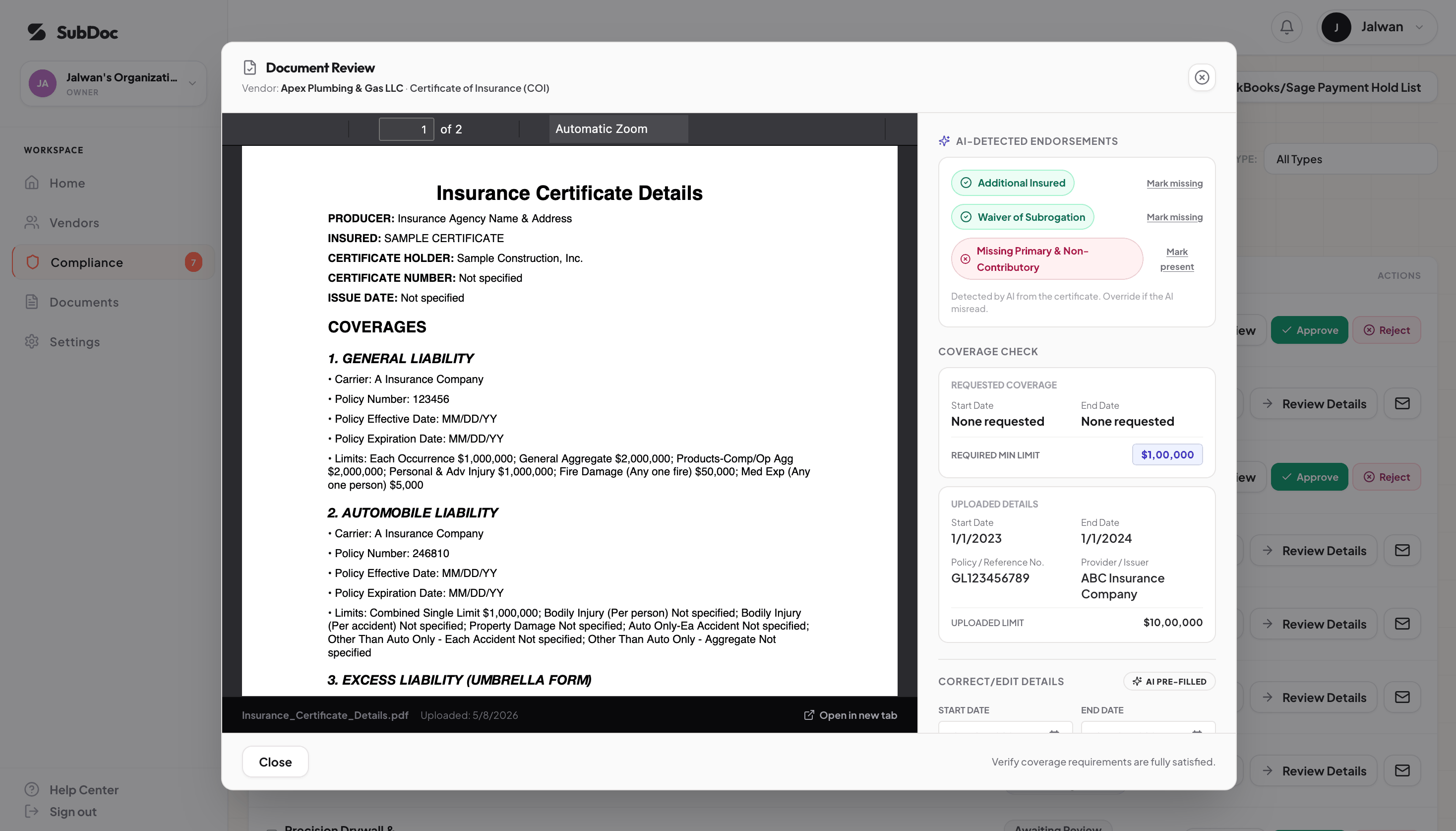
Every week across the construction industry, accounting clerks and project managers file away subcontractor Certificates of Insurance (COIs), assuming that because their company name is typed in the Certificate Holder box at the bottom of the ACORD 25 form, they are completely safe from job-site litigation.
When an electrical subcontractor causes a job-site fire or an ironworker falls from a scaffold, the general contractor submits a claim to the subcontractor's insurance company, expecting full coverage and legal defense.
Instead, the carrier responds with a formal denial letter: "Your company is listed on the certificate as a Certificate Holder, not an Additional Insured. You have no legal rights to defense or indemnification under this policy."
The Standard ACORD 25 Disclaimer Trap
Every standard ACORD 25 certificate contains the following explicit disclaimer at the top: "This certificate is issued as a matter of information only and confers no rights upon the certificate holder. This certificate does not affirmatively or negatively amend, extend or alter the coverage afforded by the policies below." In legal disputes, courts consistently rule that this disclaimer trumps whatever is typed on the certificate.
What Is a Certificate Holder?
A Certificate Holder is simply the named recipient of an ACORD 25 Certificate of Liability Insurance. It serves as an informational record showing that an insurance policy existed for the named insured at the exact moment the certificate was printed.
Being listed as a Certificate Holder provides only two very narrow functions:
- Proof of Policy Existence: It provides visual confirmation that the trade subcontractor had an active policy number, effective dates, and stated limits on the date of issuance.
- Mailing Address for Notices: It indicates where the insurance agency should mail informational updates if the policy changes (though standard certificates do not create a legal obligation for the insurer to do so).
What a Certificate Holder Does NOT Get
- • Zero legal defense in a lawsuit ($0 paid for defense attorneys).
- • Zero indemnity or settlement payout coverage under the subcontractor's policy limits.
- • Zero right to file a direct insurance claim with the subcontractor's insurance company.
- • Zero protection against third-party subrogation lawsuits from the sub's carrier.
What Is an Additional Insured?
An Additional Insured (AI)is a third-party organization (such as a general contractor, project owner, construction manager, or property management entity) that has been formally added to the subcontractor's master insurance policy through an executed policy endorsement schedule.
When you hold verified Additional Insured status, you obtain direct contractual rights under the policy:
Carrier-Paid Defense
If an injured worker or third party sues your business for bodily injury or property damage arising from the sub's operations, the subcontractor's insurer must hire and pay your defense legal counsel outside your policy deductible.
Direct Indemnity
Settlements and court judgments resulting from the subcontractor's work are paid directly from the subcontractor's policy limits, shielding your balance sheet and cash reserves.
Loss Record Defense
By transferring the financial burden to the subcontractor's carrier, you prevent claims from hitting your company's master loss history, keeping your annual insurance premiums and EMR rates stable.
Side-by-Side Comparison: Certificate Holder vs Additional Insured
The table below provides a detailed breakdown of coverage, legal defense, and administrative rights between both roles:
| Coverage Dimension | Certificate Holder | Additional Insured |
|---|---|---|
| Primary Legal Status | Informational recipient only (Proof of Policy Snapshot) | Officially endorsed protected party under the master insurance policy |
| Right to Carrier-Funded Legal Defense | None ($0 defense coverage provided by insurer) | Full legal defense team assigned and paid by the subcontractor's carrier |
| Direct Claim Payout & Settlement Coverage | None (cannot receive indemnity or claim proceeds) | Direct indemnity coverage up to policy limits for vicarious liability |
| Protection Against Completed Operations Claims | None | Yes, when ISO CG 20 37 endorsement is attached to the policy |
| ACORD 25 Proof Requirement | Legal corporate name in Certificate Holder box only | ADDL INSD box checked + formal policy endorsement schedule attached |
| Right to Notice of Policy Cancellation | Informational request only (not legally binding on carrier) | Protected by formal endorsement if cancellation notice rider is attached |
| Protection for Master Policy Claims Record | None (GC's own insurance must defend and pay all claims) | Shields the GC's loss history and Experience Modification Rate (EMR) |
The Evolution of ISO Form CG 20 10: 1985 vs 2004 vs 2013
The Insurance Services Office (ISO) publishes standardized endorsement forms used across the insurance industry. Understanding which edition of the CG 20 10endorsement is attached to your subcontractor's policy is essential, as older and newer editions provide vastly different levels of protection.
Key ISO Language: Liability 'arising out of your work'
Covered both ongoing and completed operations in one form. Courts interpreted this broadly, often forcing the insurer to defend even when the Additional Insured was solely at fault.
Key ISO Language: Liability 'caused in whole or in part by your acts or omissions'
Strictly eliminated coverage for the Additional Insured's sole negligence. Removed completed operations from CG 20 10, requiring the separate CG 20 37 form.
Key ISO Language: Coverage limited to the extent permitted by law and contract terms
Prevents the Additional Insured from receiving broader coverage or higher limits than explicitly mandated in the executed written subcontract agreement.
Key Takeaway for Contract Negotiations
Under the modern 04/13 edition, courts will strictly examine the underlying subcontract. If your contract only asks for $1,000,000 in coverage, but the subcontractor holds a $5,000,000 policy, the 2013 endorsement caps your Additional Insured protection at $1,000,000. Always ensure your contract specifies that Additional Insured coverage applies to the full policy limits maintained by the subcontractor.
The Ongoing vs Completed Operations Divide: Why CG 20 10 Alone Fails
One of the most dangerous blind spots in subcontractor insurance management is accepting an ACORD 25 that only includes the CG 20 10 endorsement without CG 20 37.
Under modern ISO forms (post-2004 revisions), the CG 20 10 endorsement strictly limits coverage to liability caused by "your ongoing operations performed for that additional insured."
This means the exact moment the subcontractor finishes their scope, packs up their tools, and leaves the job site, all Additional Insured protection under CG 20 10 ceases permanently.
Real-World Latent Defect Claim Example:
Month 1: A commercial plumbing subcontractor installs water supply lines on floors 3 through 6 of a multi-family project.
Month 3: The building receives a certificate of occupancy, tenants move in, and the plumbing contractor demobilizes.
Month 8: A compression fitting fails on the 5th floor over a weekend, causing $350,000 in water damage to finished drywall, flooring, and tenant property.
The Outcome: If the general contractor only obtained CG 20 10, the plumbing insurer will deny the claim completely because operations were completed months earlier. With CG 20 37 (Completed Operations) attached, the insurer must cover the entire $350,000 claim.
Scheduled vs Blanket Endorsements: The Prior Contract Rule
Insurance carriers provide Additional Insured coverage using one of two endorsement structures:
Scheduled Endorsements
Explicitly types your company's corporate name and project location directly into the schedule box on the endorsement page. Clear and unequivocal, but requires the broker to manually issue a custom endorsement for every job.
Blanket (Automatic) Endorsements
Automatically covers any party the named insured has agreed in writing to add as an Additional Insured (e.g., ISO CG 20 33 or CG 20 38). Highly convenient, but comes with a strict legal condition.
The Prior Executed Written Contract Trap
Every blanket Additional Insured endorsement requires that a written contract requiring Additional Insured status must be fully executed by both parties prior to the date of loss. If a subcontractor begins work on a verbal handshake, an unsigned work order, or a proposal that is signed after an accident occurs, the insurance carrier has full legal grounds to deny Additional Insured coverage.
The 6-Point ACORD 25 Audit Checklist for Contractors
Before allowing any trade subcontractor on site or releasing a progress payment, have your project management or accounting team execute this 6-point verification audit:
1. Inspect the 'ADDL INSD' Column
Ensure an 'X' or 'Y' is marked in the ADDL INSD column next to Commercial General Liability, Auto Liability, and Umbrella/Excess Liability.
2. Verify the 'SUBR WVD' Column
Confirm that Waiver of Subrogation is checked across General Liability and Workers' Compensation rows.
3. Audit the Description of Operations Text
Ensure the box explicitly names your legal entity as an Additional Insured on a primary and non-contributory basis for both ongoing and completed operations.
4. Verify Exact Legal Entity in Certificate Holder Box
Confirm your full legal company name and mailing address are accurately typed, matching your corporate registration exactly (not an informal DBA or trade nickname).
5. Demand the Actual Endorsement Riders
Never rely on the certificate alone. Require the broker to provide copies of the attached endorsement forms: CG 20 10, CG 20 37, CG 20 01, and CG 24 04.
6. Check Policy Exclusions (Action Over / Residential)
Scan the policy endorsement list for dangerous exclusions, including Action Over / Labor Law exclusions (in NY/CA/FL) or multi-family residential exclusions that gut coverage.
How SubDoc Eliminates Manual Endorsement Verification
Manually reading through multi-page policy endorsement attachments and cross-checking ISO form numbers for dozens of trade subcontractors takes hours and creates severe administrative bottlenecks.
SubDoc provides an automated Certificate of Insurance (COI) tracking platform built specifically for general contractors, trade builders, and property managers:
- 5-Second AI OCR Extraction: Automatically reads uploaded ACORD 25 certificates and attached PDF policy riders, capturing policy numbers, limits, and expiration dates instantly.
- Automated Endorsement Rule Engine: SubDoc verifies whether Additional Insured (CG 20 10 / CG 20 37), Primary & Non-Contributory (CG 20 01), and Waiver of Subrogation (CG 24 04) clauses are attached and active.
- Passwordless Broker Upload Links: Insurance brokers receive secure, one-click upload magic links to submit renewed certificates directly without creating accounts or remembering passwords.
- Automated Renewal Alerts: Continuous background monitoring alerts your team at 90, 60, 30, 14, and 7 days before expiry, and one click sends the vendor a secure upload link, preventing coverage gaps.