When general contractors, developers, and project owners hire trade subcontractors, they include insurance clauses in the subcontract agreement. Among these requirements, two terms appear in almost every standard contract: Primary and Non-Contributory wording and a Waiver of Subrogation.
While these two endorsements are often mentioned in the same breath alongside Additional Insured status, they serve completely different legal functions during an insurance claim. Confusing them, or assuming that an Additional Insured endorsement automatically includes both, is one of the most expensive mistakes construction companies make.
In this guide, we break down the exact legal definitions, ISO endorsement form numbers, claim mechanics, and real-world scenarios so you can verify that your job-site risk transfer actually holds up in court.
Primary Non-Contributory vs. Waiver of Subrogation: The Short Answer
Primary and non-contributory decides who pays first. Waiver of subrogation decides who can be sued afterward.Primary and non-contributory wording makes the subcontractor's policy pay before yours, without asking your insurer to share the loss. A waiver of subrogation stops the subcontractor's insurer from suing you to recover what it paid. You usually need both, and neither exists just because a box is checked on the certificate.
| Primary & Non-Contributory | Waiver of Subrogation | |
|---|---|---|
| Question it answers | Whose policy pays first? | Can the sub's insurer come after you once it pays? |
| When it matters | During the claim | After the claim is paid |
| Typical ISO form | CG 20 01 | CG 24 04 (GL) · WC 00 03 13 (WC) |
| Policies it's requested on | General Liability (often Umbrella too) | General Liability, Auto and Workers' Comp |
| Without it | Your insurer may have to share the loss, hitting your loss history | The sub's carrier can sue you to recover its payout |
| How to verify | Ask for the endorsement page; the ACORD 25 has no PNC checkbox | "SUBR WVD" box on the ACORD 25, backed by the endorsement page |
The Three Pillars of Contractor Risk Transfer
To understand how insurance protection works on a commercial job site, think of risk transfer as a three-legged stool:
Additional Insured (AI)
Who is covered: Adds the general contractor or owner to the subcontractor's policy so they are protected against third-party lawsuits arising from the sub's work.
ISO CG 20 10 / CG 20 37Primary & Non-Contributory
Who pays first: Forces the subcontractor's policy to pay out first without asking the GC's insurance policy to contribute a single dollar.
ISO CG 20 01Waiver of Subrogation
Who cannot be sued: Prevents the subcontractor's insurance carrier from suing the GC or owner after paying a claim to recover their money.
ISO CG 24 04 / WC 00 03 13ISO Endorsement Form Comparison Matrix
The table below outlines the standard ISO endorsement forms used across Commercial General Liability, Commercial Auto, and Workers' Compensation policies:
| Endorsement Name | ISO Form Code | Policy Line | Legal Function |
|---|---|---|---|
| Primary and Non-Contributory (CG 20 01) | CG 20 01 04 13 (or CG 20 01 12 19) | Commercial General Liability (CGL) | Forces the subcontractor's Commercial General Liability policy to pay first and prevents their insurer from asking the GC or owner's insurer to share claim costs. |
| Waiver of Subrogation (CG 24 04) | CG 24 04 05 09 (or CG 24 04 12 19) | Commercial General Liability (CGL) / Auto | Stops the subcontractor's liability insurer from suing the general contractor or property owner to recoup claim settlements after payment. |
| Workers' Comp Waiver of Subrogation | WC 00 03 13 | Workers' Compensation & Employer's Liability | Prevents the subcontractor's Workers' Comp insurer from filing a third-party subrogation lawsuit against the GC after paying injury benefits to a worker. |
| Additional Insured (Ongoing Operations) | CG 20 10 04 13 (or CG 20 33 / CG 20 38) | Commercial General Liability (CGL) | Adds the general contractor and project owner as protected insureds for bodily injury and property damage occurring during active construction. |
| Additional Insured (Completed Operations) | CG 20 37 04 13 | Commercial General Liability (CGL) | Extends Additional Insured protection for property damage or structural defects occurring after the project is completed and handed over. |
Deep Dive: What Is Primary and Non-Contributory (CG 20 01)?
To understand why Primary and Non-Contributory is required, you must understand how standard commercial insurance policies behave when multiple policies cover the same incident.
Under Section IV of a standard ISO Commercial General Liability (CGL) policy, there is an Other Insurance condition. This condition states that if another valid policy covers the same loss, all insurers will share the cost proportionally (either by equal shares or proportional limits).
Without Primary and Non-Contributory endorsement wording, if a subcontractor causes an accident on your job site and an injured party sues both the sub and the GC:
- The subcontractor's insurance carrier will only pay a portion of the settlement.
- The subcontractor's carrier will demand that the general contractor's master liability policy contribute the remaining share.
- The GC's loss history is affected, causing their future insurance premiums and EMR safety ratings to increase.
What CG 20 01 Fixes
The ISO CG 20 01 endorsement modifies the Other Insurance clause. It explicitly states that the subcontractor's policy will respond as Primary (paying the first dollar of defense and indemnity up to policy limits) and will be Non-Contributory (refusing to seek financial contribution from the GC's or owner's insurance).
Deep Dive: What Is a Waiver of Subrogation (CG 24 04 & WC 00 03 13)?
Subrogation is the legal right of an insurance company to step into the shoes of its policyholder after paying out a claim and sue any third party who may have contributed to the loss in order to recoup their payment.
Here is how an unprotected subrogation lawsuit unfolds on a construction project:
Step 1: An electrical subcontractor's apprentice trips over loose debris on a walkway and fractures an arm.
Step 2: The subcontractor's Workers' Compensation insurer pays $75,000 in medical bills and disability payments to the worker.
Step 3: After paying the claim, the Workers' Comp insurer files a third-party subrogation lawsuit against the general contractor, claiming the GC failed to maintain a clean and safe common job-site walkway.
Even though the subcontractor agreed that job-site injuries were their responsibility, their insurance company never signed that contract. Subrogation allows the insurance company to bypass the subcontract and sue the GC directly.
How Waiver of Subrogation Protects You
When a subcontractor adds endorsement CG 24 04 (for General Liability) or WC 00 03 13 (for Workers' Compensation), their insurance company waives their legal right to recover payments from the general contractor or project owner. Once the insurer pays the claim, the matter is closed permanently.
Real-World Claim Comparison: With vs. Without Endorsements
Let us look at what happens when a $500,000 property damage claim occurs (such as a mechanical subcontractor piercing a main water riser on the fourth floor of a commercial building):
Scenario A: Missing Endorsements
The GC only obtained an ACORD 25 listing them as Certificate Holder without verified CG 20 01 and CG 24 04 endorsements:
- • The subcontractor's insurer pays $250,000, but demands the GC's master policy contribute the remaining $250,000.
- • The sub's insurer then files a subrogation lawsuit against the GC, claiming site lighting contributed to the accident.
- • Result: The GC pays a $25,000 deductible, experiences a multi-year loss on their record, and pays increased renewal premiums for 3 years.
Scenario B: Verified CG 20 01 & CG 24 04
The GC verified Additional Insured, Primary & Non-Contributory, and Waiver of Subrogation endorsements before work started:
- • The subcontractor's insurance carrier assumes 100% defense and pays the full $500,000 settlement.
- • The sub's insurer is legally barred from asking the GC's insurer to contribute.
- • The sub's insurer cannot file a subrogation lawsuit against the GC.
- • Result: $0 out-of-pocket cost to the GC and zero impact on the GC's insurance claims history.
Blanket vs. Scheduled Endorsements: The Written Contract Rule
When insurance brokers issue endorsements, they typically provide either Scheduled or Blanket forms:
- Scheduled Endorsements: Explicitly name your company and project on the endorsement page (e.g., "ABC General Contractors LLC, 123 Main Street Project"). These are clear and specific, but take longer for brokers to issue.
- Blanket Endorsements (Automatic Status): State that any person or organization the insured is required by written contract to add as an Additional Insured or provide a Waiver of Subrogation is automatically covered.
The Critical Written Contract Requirement
If your subcontractor has a Blanket endorsement, the endorsement is completely invalid unless there is a signed, written subcontract agreement executed prior to the loss. If a verbal agreement or unsigned change order is in place when an accident happens, the insurance carrier will deny Additional Insured and Primary & Non-Contributory coverage.
How to Verify Endorsements on ACORD 25 Forms
On a standard ACORD 25 Certificate of Liability Insurance form, you will notice two narrow columns next to each policy line:
- ADDL INSD: A checkbox indicating Additional Insured status.
- SUBR WVD: A checkbox indicating Waiver of Subrogation.
However, the bottom disclaimer of every ACORD 25 certificate explicitly states: "This certificate is issued as a matter of information only and confers no rights upon the certificate holder."
If a claims adjuster reviews a file after a serious accident and discovers that the insurance broker checked the boxes on the COI but never actually attached the underlying CG 20 01, CG 20 10, or CG 24 04 endorsements to the subcontractor's master policy, the insurance company will deny the claim.
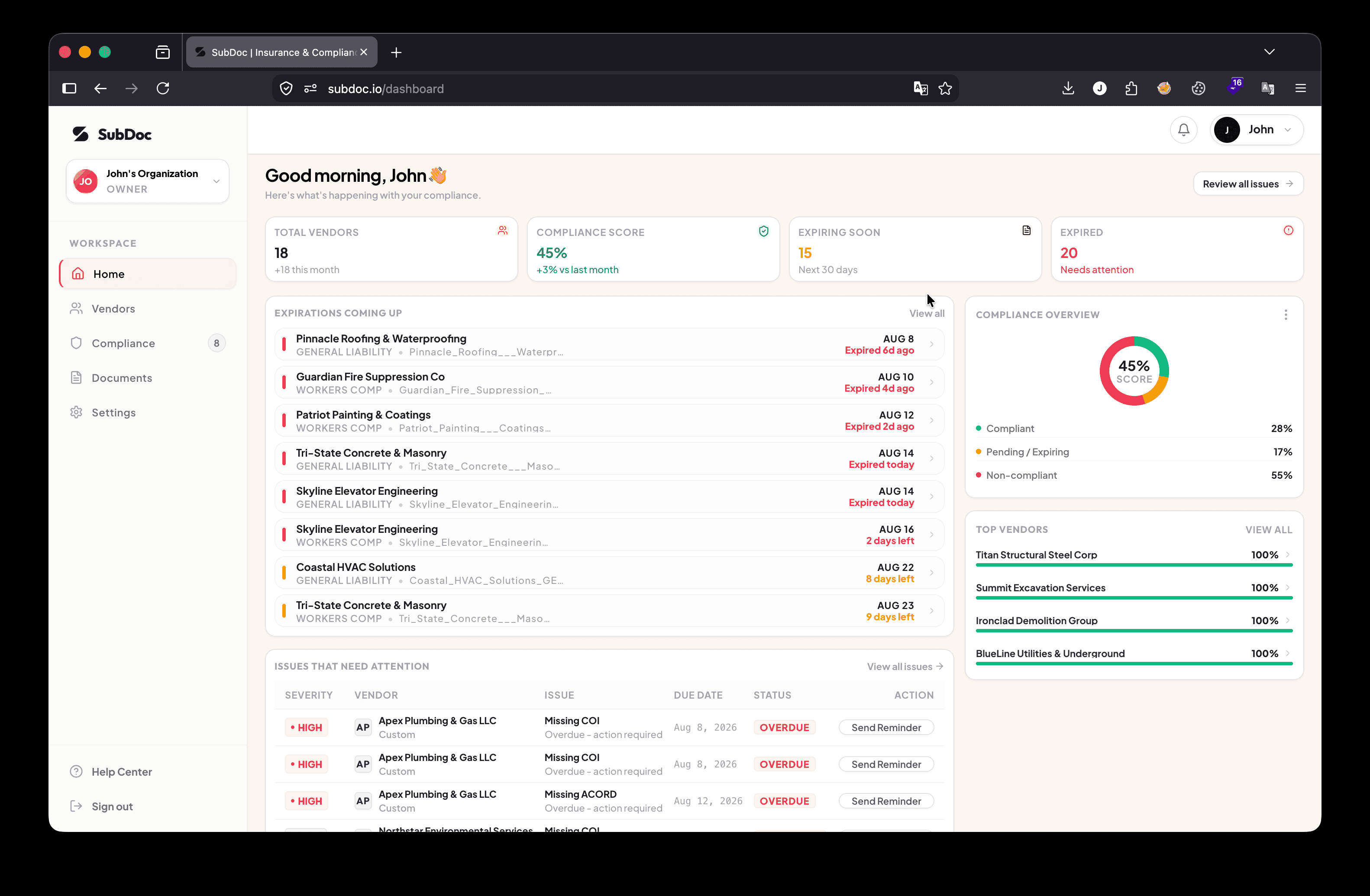
This is why relying on manual visual checks or spreadsheet tracking creates blind spots. Modern compliance software like SubDoc uses automated AI OCR to verify that both the ACORD 25 certificate and the underlying endorsement PDF riders are attached, active, and matching your contract requirements before work begins.