ACORD 855 NY: How to Review the Construction Insurance Addendum
ACORD 855 NY is a New York construction certificate addendum attached to ACORD 25. It discloses policy details that need more than a limits check. This guide helps GC administrators match the documents, read the answers and send specific questions to a qualified insurance reviewer.
Read ACORD 855 as a disclosure, then verify the evidence. A Yes can report a restriction. Match each answer to your contract, request the supporting policy pages, and keep unresolved items with a named reviewer. The addendum cannot change the insurance policy.
Key Takeaways
- Check whether your contract or requesting agency requires the addendum; do not assume every New York job does.
- Read both pages. Favorable answers still need evidence, and blanks need clarification.
- Keep the certificate, addendum, issued endorsements and review decision together.
- Have counsel and the carrier confirm legal or coverage questions before accepting a disputed provision.
What is ACORD 855 NY, and how does it relate to ACORD 25?
Start with the two-page ACORD 855 NY (2014/05) approved form hosted by NY DFS. Its A–M fields help direct a review of construction liability terms. Download that reference if you need to identify the form, then ask the producer for a completed version for the actual policy and project.
ACORD 855 vs ACORD 25: use the ACORD 25 definition for the base certificate. Here, the task is reconciling the addendum with that certificate and the evidence behind its answers. A complete-looking upload can still leave a contract requirement unanswered.
When does a New York project ask for this addendum?
Read the insurance exhibit and submission instructions first. The NYSDOT consultant insurance requirements expressly call for ACORD 25 accompanied by ACORD 855. They also specify contract identification, disclosure of deductibles, self-insured retentions and aggregate limits, and an authorized signature and date. That is a concrete program requirement, not a statewide rule for every contractor.
The OGS-hosted insurance requirements guidance, updated September 2021, recommends the addendum for construction and describes agency-specific selection of acceptable forms. Treat it as dated guidance, not a new 2026 mandate. Record the clause that applies to your job and who can approve an exception. If the submission instructions conflict, ask the contracting party to resolve them.
How do you match ACORD 855 to the insured and policy?
Before reading the answers, put the subcontract, certificate and addendum beside one another. Use the ACORD 25 inspection checklist for the separate certificate check. Then establish which policy the addendum describes. These identity checks save the reviewer from interpreting pages that belong to another entity or policy year.
- Entity: reconcile the named insured with the legal subcontracting party. Ask for clarification of a parent, subsidiary or trade-name difference.
- Policy: match the number, carrier and effective date across the relevant pages. Investigate conflicting dates before carrying an approval forward.
- References: reconcile certificate and revision identifiers where provided, and check the agency customer reference across both addendum pages.
- Completion: obtain the second page and authorized representative’s signature and date. A missing answer remains an open item.
Keep a short discrepancy list. Write “addendum lists GL-4102; certificate lists GL-4103” instead of “wrong insurance.” The producer can investigate a precise mismatch without guessing what your team needs.
How do you read ACORD 855 questions A–M?
The approved form changes question direction. A, B and D identify categories or forms; C discloses restrictions. E, F and M ask about protections. G–L ask about removed, modified or restricted coverage. Never turn the page into a count of Yes boxes.
Use this original worksheet beside an ACORD 855 sample or completed submission. “Favorable” means worth checking against the requirement, not accepted coverage. “Adverse” means route the issue for review; “unclear” means obtain an explanation. The suggested owners below are workflow assignments for your team.
| Question group | Response and routing | Document to inspect | Escalation owner |
|---|---|---|---|
| A: Insurer category | Potentially favorable: category meets contract criteria. Adverse: it conflicts. Unclear: missing category or placement evidence. This is not a yes/no field. | Carrier identification and required placement evidence. | Insurance reviewer; producer supplies evidence. |
| B: GL form basis | Potentially favorable: reviewed wording fits the requirement. Adverse: a confirmed conflict. Unclear: unfamiliar wording without supporting pages. Category alone is not a quality grade. | Coverage form and applicable amendments. | Broker or insurance reviewer. |
| C: Operations restrictions | Potentially favorable: confirmed fit with the actual work. Adverse: a conflicting restriction. Unclear: blank fields or insufficient detail about scope. Request clarification. | Declarations, restrictions and scope of work. | Project manager plus insurance reviewer. |
| D: Additional insured forms | Potentially favorable: selected forms match issued evidence and requirements. Adverse: confirmed mismatch. Unclear: missing forms, editions or schedules. This is not a yes/no field. | Issued endorsements, editions and schedules. | Producer and insurance reviewer. |
| E: GL primary and noncontributory treatment | Potentially favorable: supported Yes when required. Adverse: No against that requirement. Unclear: blank or unsupported answer. Route any proposed exception. | Other-insurance wording and any endorsement. | Broker; authorized contract decision-maker. |
| F: Advance cancellation notice to additional insured | Potentially favorable: Yes with matching notice terms. Adverse: No when notice is required. Unclear: missing recipient or conditions. Request the actual provision. | Notice provision, recipient and conditions. | Producer and contract administrator. |
| G: Contractual liability changes | Potentially favorable: no reported change. Adverse: Yes flags a restriction. Unclear: blank or conflicting evidence. Check the underlying definition too. | Insured-contract definition and amendments. | Insurance reviewer; counsel for contract implications. |
| H: Employers-liability exception changes | Potentially favorable: no reported change. Adverse: Yes flags modification. Unclear: unexplained or conflicting evidence. Obtain the applicable wording. | GL exclusion, exception and modifying forms. | Broker and counsel as needed. |
| I: Employee-injury limitations | Potentially favorable: no reported change. Adverse: Yes flags an additional-insured coverage concern. Unclear: blank or conflicting evidence. Escalate against the job’s requirements. | Injury exclusions and additional insured wording. | Insurance reviewer and counsel. |
| J: Earth movement, excavation and explosion/collapse/underground restrictions | Potentially favorable: no reported change, subject to scope review. Adverse: Yes identifies a restriction affecting the work. Unclear: missing wording or excavation details. | Earth-movement and related exclusions; work description. | Project manager and broker. |
| K: Cross-liability restrictions | Potentially favorable: no reported change. Adverse: Yes flags restrictions needing specialist review. Unclear: blank or conflicting evidence. Do not resolve this from the certificate alone. | Insured-versus-insured exclusion and exceptions. | Insurance reviewer; counsel as needed. |
| L: Subcontracted-work damage restrictions | Potentially favorable: no reported change. Adverse: Yes flags restrictions. Unclear: missing or contradictory wording. This answer cannot approve the whole policy. | Your-work exclusion, exception and amendments. | Broker or insurance reviewer. |
| M: Excess/umbrella primary and noncontributory treatment | Potentially favorable: either supported Yes option. Adverse: No when the contract requires this treatment. Unclear: blank or missing provision. Review separately from GL. | Excess/umbrella provision or issued endorsement. | Producer and insurance reviewer. |
For D, use the ISO endorsement-code reference to identify what to request. Do not infer an edition date or schedule from a checked form number. For E and M, keep the GL and excess/umbrella evidence separate.
Which documents support ACORD 855 answers?
Give each open item a requirement, received answer, missing evidence, owner and response date. Use statuses such as awaiting evidence, specialist review, accepted and exception approved. Record acceptance only after the assigned reviewer resolves the question. These two hypothetical mismatches show the handoff.
Distinguish three outcomes in the register. A clerical correction reconciles what the documents say. A coverage change needs issued evidence from the insurer. A contract exception records an authorized decision to accept a departure. Do not label all three “corrected,” because the next reviewer needs to know which requirement was met and which was waived.
What if ACORD 855 reports a height restriction?
Imagine Cedar Masonry LLC is hired for exterior repairs on a six-story building. C describes a restriction above three stories. The certificate’s limits meet the subcontract, but that does not resolve the mismatch. The coordinator logs the restriction, attaches the work description and asks the producer for the relevant endorsement and written clarification. The project manager confirms the work heights; the insurance reviewer and counsel assess the contract implications with the carrier.
The item stays in specialist review. A revised certificate repeating the limits cannot close it. Record the actual resolution: corrected evidence, carrier-issued coverage changes if obtained, or an authorized contract decision. Do not tell the subcontractor that changing the answer will fix the policy.
What if the listed additional insured endorsement is missing?
On a different hypothetical job, D selects CG 20 37, but the packet contains only CG 20 10 for policy GL-4103. The contract requires completed-operations additional insured evidence. Request the missing issued form and schedule, or a producer explanation of the selection. Use the ongoing versus completed-operations guide to frame the question. The reviewer checks the actual editions, applicable work and contract conditions.
Separately, a favorable E answer does not close a waiver requirement. Our primary and non-contributory versus waiver guide explains those distinct requests. Keep each contract obligation on its own review row so one document cannot accidentally close an unrelated requirement.
Does ACORD 855 change coverage or remove exclusions?
The addendum is informational and creates no certificate-holder rights. Completing it cannot remove a Labor Law exclusion, add an insured or guarantee a claim outcome. A favorable summary can also conflict with supplied wording. Send that conflict to the producer and carrier rather than choosing whichever page looks more reassuring.
The 2021 OGS review guidance calls for comparing answers with the particular contract. For legal questions, including Labor Law and indemnity wording, confirm with counsel and the carrier. An administrator’s job is to identify the discrepancy and preserve the response, not issue a coverage opinion.
Does ACORD 855 prove workers’ comp or disability coverage?
The OGS guidance states that ACORD certificates are not acceptable workers’ compensation and disability benefits proof for New York State governmental entities. Keep those evidence requests separate from the liability addendum. In particular, a response about employee-injury limitations in GL does not close your workers’ compensation document request.
Use the New York Workers’ Compensation Board’s official forms directory to identify the proper channels. It lists C-105.2 for private-carrier workers’ compensation coverage and notes the State Insurance Fund’s U-26.3 equivalent. DB-120.1 addresses disability benefits coverage. Obtain carrier-issued forms through the carrier or licensed agent as directed; do not create substitutes.
Check the authority’s instructions for self-insurance or any claimed exemption. Ask which evidence applies to that employer and contract. Put the accepted document and reviewer’s decision in the packet, keeping the liability, workers’ compensation and disability checks individually visible.
How do you request a corrected ACORD 855?
Send one focused request for the missing New York construction insurance documents. Include the contract excerpt, policy reference and exact discrepancy. Give a response date tied to your review schedule. This reusable message keeps a document correction separate from a request to change insurance coverage:
Subject: [Project / contract] ACORD 855 clarification, [insured], [policy]
Please review item [letter]. The addendum states [answer], while [document/page or work description] states [conflicting detail]. Attached is contract requirement [reference]. Please provide the supporting issued policy provision, endorsement and schedule, and clarify whether the addendum needs correction. If the current policy cannot meet the requirement, please say so for our reviewer. Send the response and any revised complete addendum to [owner] by [date].
Preserve the received version, correction, supporting pages and dated decision under your organization’s retention instructions. At renewal, reopen the comparison for the new policy period. Store prior evidence so the team can reconstruct what it reviewed; keeping an old packet and collecting current evidence are separate tasks.
Can SubDoc review ACORD 855 answers?
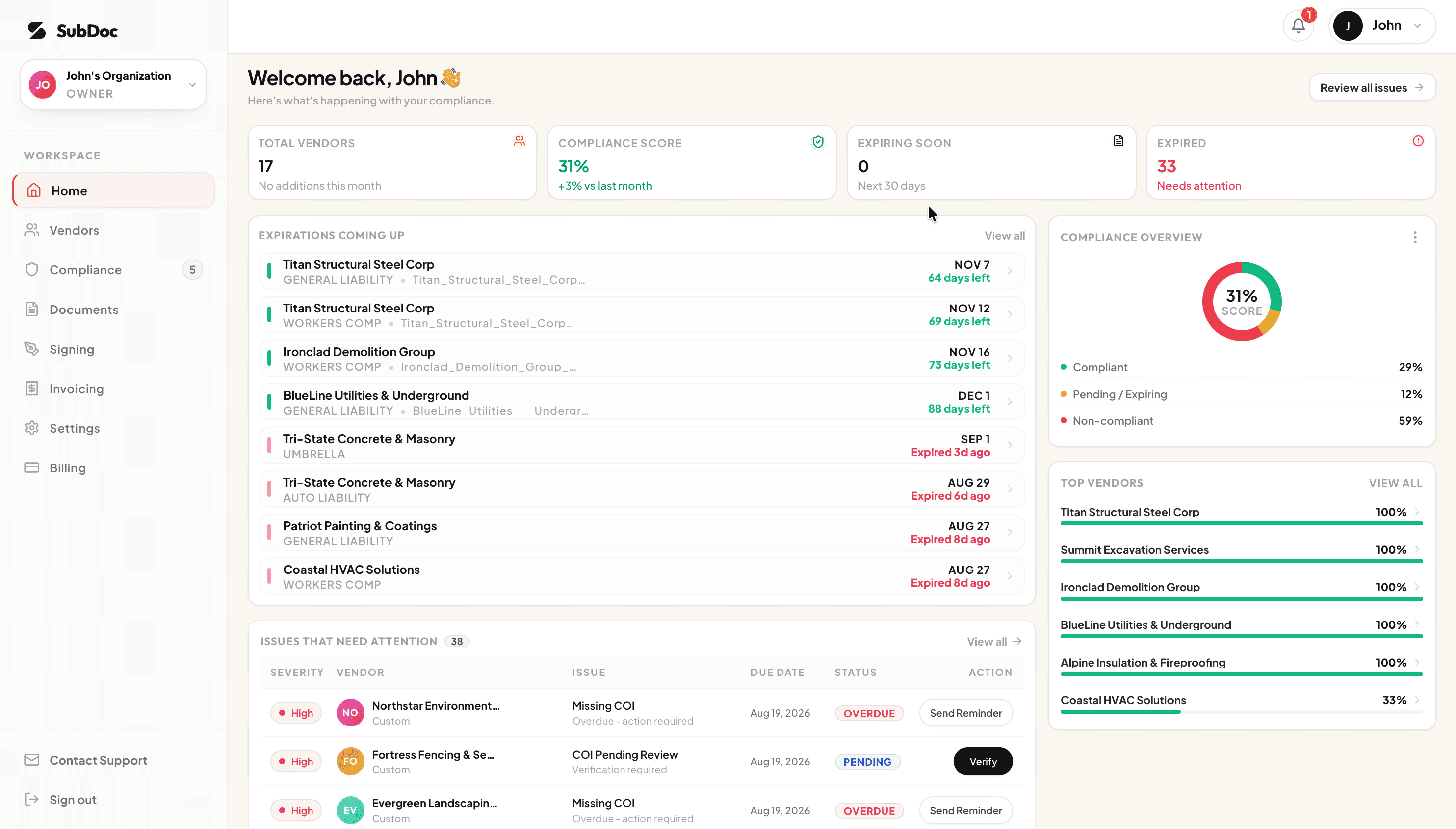
- Keep supplied addenda and supporting documents organized with vendor insurance records.
- Have your qualified reviewer interpret A–M answers, exclusions and contract requirements; SubDoc does not automatically parse or approve ACORD 855 answers.
- Assign vendor and broker follow-up to your team. Automated vendor and broker chasing is disabled.
Close the ACORD 855 review when the evidence and authorized decision are recorded. Leave the owner and next action visible for anything still unresolved.
Frequently Asked Questions
ACORD 25 summarizes liability insurance information. ACORD 855 NY accompanies it with construction-specific disclosures about policy terms and restrictions. Review the two together with the contract and supporting policy documents. Neither form creates coverage or replaces the issued policy and endorsements.
Do not assume a universal requirement. Check the project contract and requesting organization’s instructions. NYSDOT’s consultant insurance instructions expressly require the addendum alongside ACORD 25. Other projects need their own applicability check; confirm the required forms with the contracting party and its insurance reviewer.
No. Read the statement before interpreting the response. E, F and M concern protections, while G through L describe coverage restrictions or changes. Even a favorable response needs supporting evidence and a comparison with the project requirements. A blank or conflicting answer stays unresolved.
The New York Department of Financial Services hosts the approved two-page ACORD 855 NY (2014/05) PDF, linked in this guide. Use it as a reference. Ask the producer for the completed addendum accepted for your project, including both pages, the authorized representative’s signature and the date.
No. Completing the addendum does not remove a policy exclusion. Refer Labor Law wording to counsel and the carrier for confirmation. Workers’ compensation and disability benefits require separate evidence appropriate to the requesting authority; use the Workers’ Compensation Board’s official guidance and carrier channels for those forms.
Related Guides
Keep the review packet within reach
Organize vendor insurance documents in SubDoc while your team handles evidence requests and qualified reviewers resolve policy questions.