How Long Should You Keep Subcontractor Certificates of Insurance?
Keep certificates of insurance for the period in your counsel-approved retention schedule, including expired certificates for relevant work years. There is no universal seven-year rule. Set the duration and starting event from your contracts, applicable requirements and preservation obligations before authorizing disposal.
Keep COIs for the period your counsel-approved retention schedule requires. Preserve expired certificates with the related contract and policy evidence. Set the duration and starting event with counsel, confirm insurance needs with your broker or carrier, and check preservation obligations before deletion. Certificate expiration alone is not a disposal date.
Key Takeaways
- A COI retention period needs a defined trigger, an approved duration and a named owner.
- Keep historical evidence separate from the decision to collect future renewals.
- Preserve the contract and issued endorsement evidence alongside each relevant policy year.
- Test retrieval before closing a vendor account or changing document systems.
What determines how long a contractor should keep COIs?
Start with the project jurisdiction, signed agreements, insurance requirements and any unresolved matter. Ask counsel to turn those inputs into an instruction your controller can administer. “Keep everything for seven years” leaves unanswered which records it covers and when counting begins.
Travelers' contractual risk-transfer guidance recommends retaining project records and consulting legal counsel about duration and applicable requirements. It also calls for communicating the policy to project management. That gives you a practical starting point: obtain a written instruction and make sure the people closing projects can find it.
The uncertainty is familiar. A Construction Financial Management Association discussion describes a GC receiving conflicting advice about post-completion insurance records. That is an operational question, not authority for a retention deadline. This guide provides a worksheet for the decision; confirm the final schedule with counsel and your broker or carrier.
Why should you keep expired certificates of insurance?
A renewal answers a question about a later policy period. It does not replace the document you received while a subcontractor worked on an earlier job. Preserve expired certificate of insurance records under their original policy years so the current vendor screen does not become your entire insurance history.
Suppose an auditor asks about work performed before the vendor changed carriers. The current COI points to the wrong period. The earlier certificate helps identify the insured, carrier, policy number and dates reported then. Travelers' general-liability audit guidance specifically addresses keeping certificates covering the time subcontractors performed work, including evidence from adjoining terms when necessary.
Preserving that evidence is separate from collecting future renewals. For a current lapse, use the mid-project insurance expiration guide. For post-completion collection, have the contract's continuing requirements reviewed before stopping requests. Neither decision should overwrite the historical file.
How do statutes of repose and legal holds affect COI retention?
Keep these concepts separate in your certificate of insurance retention policy. They answer different questions, even when a lawyer considers them together:
- Retention schedule: your approved instruction identifying the records, starting event, duration and disposal process.
- Statute of repose: a legal deadline for certain claims measured from a specified event. Counsel determines applicability, the trigger and exceptions.
- Legal hold: a preservation instruction for relevant information when litigation is pending or reasonably anticipated. Follow counsel's direction on scope and release.
A repose deadline is not a universal records law or an automatic deletion date. Avoid entering “completion plus X years” because someone used it on another project. Ask which completion event counts, which obligations were considered and what happens if a dispute arises before routine disposal.
Route a claim notice or preservation concern to counsel promptly. Do not wait for a lawsuit to ask whether records must be preserved. Suspend proposed disposal while that question is reviewed, including any routine cleanup that could remove relevant emails or attachments. Record the instruction and its owner.
Which documents should stay with each policy year and project?
Build a packet someone outside the original project team can follow. Keep these document classes linked by project, subcontractor legal entity and relevant policy period:
- The original COI, corrected versions and renewal certificates for the work dates.
- Issued endorsements, referenced schedules and supporting policy pages; obtain fuller policy evidence when your reviewer requires it.
- The executed subcontract, insurance exhibit, amendments and documented exceptions.
- Work dates, completion records, return visits and relevant invoices supporting the timeline.
- Review decisions, producer correspondence, cancellation information and preservation instructions.
Each document has a job. The contract records the obligation; the certificate summarizes reported insurance; the policy and issued endorsements establish the insurance terms. The Texas Department of Insurance certificate FAQ explains that a certificate cannot go beyond the policy and that policy or endorsement copies can be provided. Do not turn a retained certificate into a coverage guarantee.
At closeout, assign this packet using the subcontractor closeout checklist. Keep the coverage explanation short in the records schedule. Our completed operations coverage definition explains that concept. If claims-made coverage is involved, ask the broker which continuity, retroactive-date and reporting-period evidence belongs in the packet. Retention alone cannot repair an insurance gap.
How do you build a COI retention schedule?
Copy this filled example into your records register. The names and project are fictional. It deliberately shows a file awaiting approval: missing legal instructions should remain visible rather than become a guessed destruction date. Use one entry per project/entity and document class, with separate policy-year references where the work crosses renewal.
| Field | Filled example |
|---|---|
| Project/entity | P-241, River Street Clinic; Alder Builders LLC / Cedar Mechanical LLC |
| Policy period | GL-218: Jan. 1–Dec. 31, 2021; GL-319: Jan. 1–Dec. 31, 2022 |
| Document class | COIs, issued endorsements and schedules, policy evidence, executed subcontract and insurance exhibit |
| Work dates | Installation: Nov. 15, 2021–Mar. 18, 2022; return visit: Sept. 6, 2022 |
| Retention trigger | Completion event and date to be confirmed against the approved schedule; do not use certificate expiration |
| Policy/counsel instruction | Pending written instruction: preserve packet; counsel to specify duration and trigger; broker/carrier to confirm insurance evidence needed |
| Legal-hold status | Unknown; no disposal until counsel checks. Record hold reference and release authority if applicable |
| Decision owner | Maya Chen, controller; project manager confirms work dates; counsel approves retention instruction |
| Retrieval location | Company records repository / P-241 / Cedar-Mechanical / Insurance / 2021 and 2022; contract in P-241 / Contracts |
Once reviewed, replace the pending instruction with the approved duration, exact trigger, approval date and schedule version. Record any continuing renewal requirement separately, including who decides when it ends. A preservation flag and a renewal task can have different owners and different end dates.
Add a proposed disposal-review date only after the trigger is verified. Treat it as a checkpoint requiring authorization, not a scheduled purge. Before disposal, the owner checks for holds, outstanding audits, claims and contract obligations, then records what was authorized and by whom.
How do you retrieve insurance records for an old project?
In October 2026, Alder receives a question about water damage at River Street Clinic. Cedar's installation crossed the 2021 and 2022 policy years, and its return visit occurred in September 2022. The coordinator finds a 2026 renewal first. Here is the retrieval test for the historical packet, without deciding which insurance responds to the reported damage.
- Reconstruct the timeline. Retrieve installation records, completion evidence and the return-visit record. Keep work dates separate from the alleged damage and discovery dates; provide all of them to the reviewer.
- Retrieve both work-year packets. Find the 2021 COI identifying GL-218 and the 2022 COI identifying GL-319. They establish what insurance details were reported for those terms, not whether this loss is covered.
- Match issued evidence. Open each term's endorsements and schedules with the supporting policy pages. Check policy numbers, insured names and referenced entities or locations. Flag missing pages for the broker.
- Retrieve the agreement. Open the executed subcontract and insurance exhibit. They show what Cedar agreed to provide. Include amendments and exceptions so the reviewer does not rely on an outdated requirement.
- Record the handoff. Give counsel and the broker or carrier the indexed packet, timeline and missing-document list. Ask counsel for preservation instructions. Record who received it and who owns the next action.
If the 2021 endorsement is missing, mark that gap plainly. Do not substitute a blank specimen or assume the 2022 form applied earlier. Ask the producer or carrier for the issued evidence and retain the request and response. An incomplete packet with a clear gap is more useful than an unexplained “insurance approved” note.
For a premium-audit request, attach the relevant work and payment records as well. The contractor insurance audit guide explains that separate exposure. A past acceptance decision should be traceable to the evidence available then, even if today's team would request more documents.
How to preserve access when a vendor leaves or software changes
A PDF linked only from a former employee's inbox is a fragile record. Before offboarding a vendor or replacing software, inventory the files and their index. Keep company-controlled copies in readable formats, identify the records owner and check access after staff changes.
Use filenames that distinguish entity, policy period and document class. Preserve received originals and identify corrections separately. After a migration, compare the inventory with the destination, open sample attachments and confirm that referenced schedules survived. Have a colleague retrieve the example packet using the register alone.
Travelers also recommends backups and maintaining electronic accessibility through system upgrades. Assign those checks to a person. Confirm download, account-closure and storage terms before a system change; a dashboard link is useful only while the underlying file remains accessible.
Can SubDoc manage your COI retention policy?
SubDoc supports centralized vendor document handling, certificate data extraction and team expiration notifications. Those features help organize the ongoing workflow. For that process, follow the subcontractor COI tracking guide. Deciding how long to keep subcontractor COIs still requires your approved schedule and a person accountable for applying it.
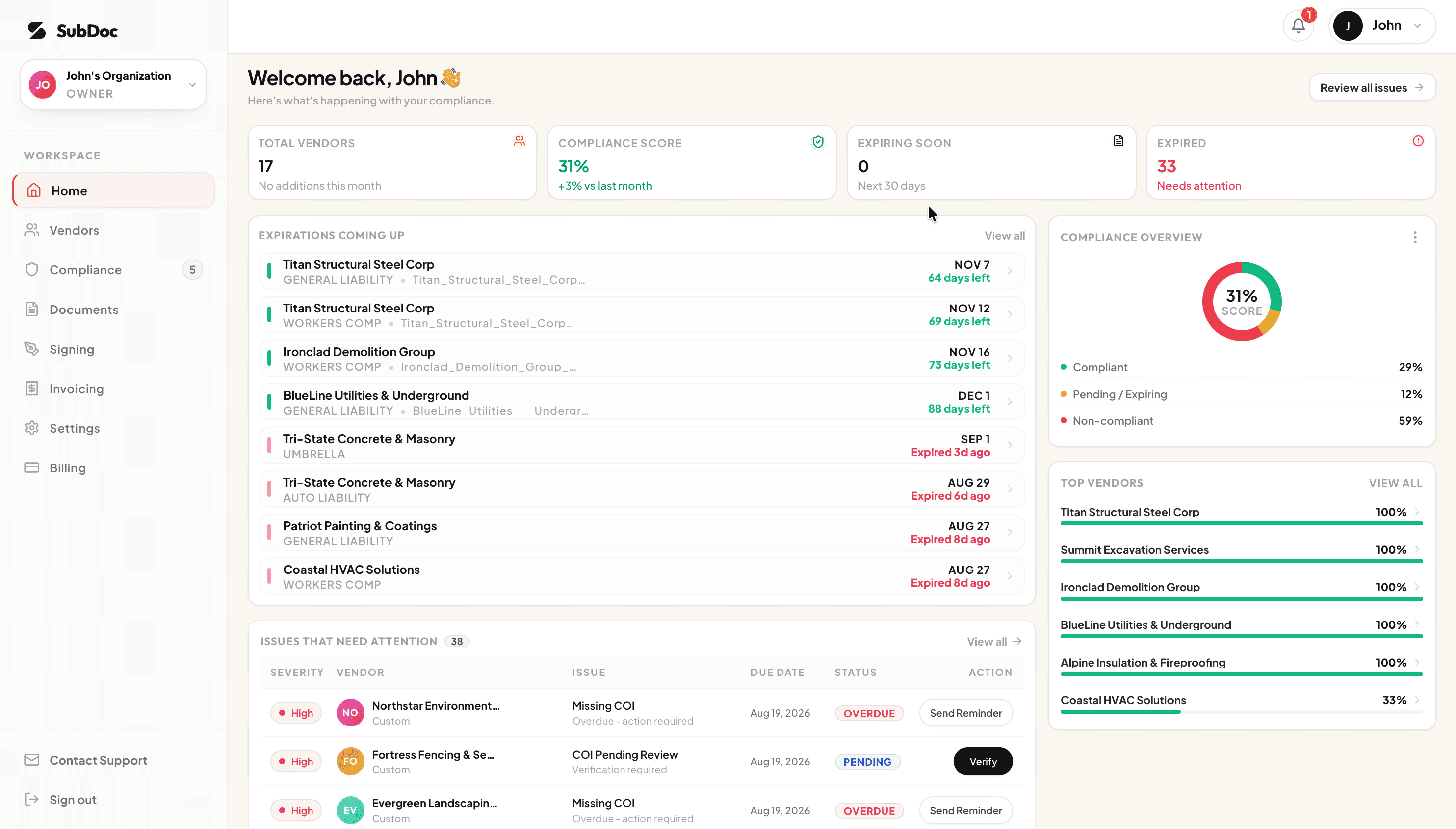
- Organize vendor insurance documents and use extracted certificate details to support review.
- Assign someone to act on team expiration notifications and handle vendor or broker follow-up. Automated chasing is disabled.
- Specify retention triggers, legal-hold handling, backups, retrieval checks and disposal authorization in your company policy.
Do not assume immutable archives, automatic legal holds, a retention-policy engine or indefinite storage. Confirm your storage and access arrangements before relying on any workspace as the sole historical repository.
How should you review old COIs before deletion?
Deciding how long to keep certificates of insurance becomes manageable when every packet has an owner, an approved instruction and a tested retrieval location. Start with one completed project, resolve the missing instructions with counsel and your carrier, then apply the schedule consistently. These questions cover the decisions that often come up during cleanup.
Frequently Asked Questions
Use a written schedule approved by counsel, with input from your broker or carrier. The period depends on applicable requirements, contracts, insurance terms and preservation obligations. Record the event that starts the period and who approves disposal. There is no universal seven-year answer for every project.
Yes, when they belong to a project or policy period still covered by your retention schedule or a preservation obligation. An expired certificate can help identify historical insurance details. Keep it with the related contract and issued policy evidence; it does not prove that coverage applies to a particular claim.
Preserving existing records and requesting future renewals are separate tasks. Review the subcontract and any continuing insurance requirements with your broker or carrier. Counsel should confirm the obligation and duration. Keep the historical file even when an authorized reviewer decides that further renewal collection is no longer required.
Do not treat a repose deadline as automatic permission to delete records. Counsel must confirm whether it applies, which event starts it, and whether exceptions or other obligations affect the decision. Before disposal, check the approved retention schedule, outstanding matters and legal holds, then document authorization.
SubDoc supports centralized vendor document organization, certificate data extraction and team expiration notifications. Your team must define and administer its retention schedule, preservation instructions and disposal approvals. Do not assume automatic legal holds, immutable archives or indefinite storage. Your team also handles vendor and broker follow-up; automated chasing is disabled.
Related Guides
Give your insurance records a clear home
Organize vendor documents in SubDoc, then use your approved retention schedule to guide preservation and review.