Subcontractor Closeout Checklist: Build a Complete Final Packet
A subcontractor closeout checklist gives a GC one place to review the final packet: completed work, final billing, releases, warranties and insurance records. Give each deliverable an owner and an acceptance decision before calling the file complete.
Build the packet from the subcontract requirements. Record what arrived, who reviewed it and whether it was accepted. Reconcile the final amount, review the appropriate releases, collect turnover documents and assign continuing insurance duties. Keep work acceptance, payment status and future obligations separate. Use the checklist and editable CSV below without signing up.
Key Takeaways
- A received document still needs review and an acceptance decision.
- Match final billing to approved changes and actual payments; keep disputed items visible.
- Confirm release wording and payment decisions with counsel, and coverage questions with your broker or carrier.
- Closing one project can leave warranties, insurance duties and the vendor relationship active.
What belongs in a subcontractor closeout package?
Start with the signed subcontract, specifications and approved changes. Your subcontractor closeout documents should answer what was delivered, what remains payable and what continues after handoff. A service trade may need a short packet; an equipment installer may owe manuals, training records, warranties and record drawings. Request only the items that apply to that scope.
The Federal Transit Administration's 2016 Construction Management Handbook groups closeout around accepted deliverables, contract settlement, final payments and records. It includes manuals, warranties and as-built documentation. This is public-transit guidance, not a statement of current private-GC legal requirements. Use its categories as a prompt, then check your own contract.
Keep three separate decisions in the record: physical work accepted, accounting reconciled and continuing obligations assigned. A superintendent's walkthrough does not establish whether a warranty was delivered. Likewise, a paid invoice does not tell the risk manager when insurance monitoring should end.
Subcontractor closeout checklist: documents and acceptance criteria
Use this construction closeout package checklist to assign review. Add the exact clause or specification reference beside each required item. If something does not apply, record why and who agreed. An empty cell leaves the next reviewer guessing.
| Deliverable | Review owner | Evidence to inspect | Acceptance test |
|---|---|---|---|
| Work acceptance | Superintendent / PM | Dated inspection, punch-list completion and required test records | Authorized reviewer accepts the identified scope. |
| Final billing and changes | Project accountant / PM | Final invoice or pay application, approved changes and payment ledger | Revised value and remaining balance reconcile. |
| Releases and signatures | Contract administrator | Applicable release, exceptions and signer authority | Form, amount and payment condition receive appropriate review. |
| Warranties | PM / owner representative | Required warranty, covered equipment and start-date evidence | Issuer, term, trigger and service contact match the requirement. |
| Technical turnover | Designated technical reviewer | Required manuals, record drawings, training and spare-parts receipts | Content and format meet the referenced specification. |
| Insurance record | Risk manager / broker | Relevant COIs, issued endorsements, policy references and insurance exhibit | Reviewer records evidence gaps and continuing duties. |
| Other contract deliverables | Contract administrator | Required payroll certifications, bond documents or permit records | Requirement is satisfied or marked not applicable with a reason. |
Track received, reviewed and accepted separately, with dates. Received means the file arrived. Reviewed means a named person checked it. Accepted means that reviewer recorded how it meets the requirement. A warranty headed with the wrong project name can be received and reviewed while still needing correction.
For an exception, record the defect, responsible person, due date and document location. The filled tracker below adds a post-closeout action so an accepted packet can still carry a scheduled warranty review or insurance evidence request.
When should you start collecting subcontractor closeout documents?
Create the deliverable list when the subcontract is set up. Our subcontractor onboarding checklist covers initial documents. Closeout uses that signed scope and insurance exhibit to identify the evidence due at the other end of the job. Avoid asking for the onboarding packet again by habit.
Before the last billing cycle, send the trade coordinator a short request showing each outstanding item, required format, recipient and contract-based due date. Ask who obtains the manufacturer warranty and who prepares record drawings. Those people may need more time than the person submitting the invoice.
Agree how corrections return to the reviewer. Keep a version number and a single packet index so accounting does not use the first invoice while the PM reviews a replacement. Put payment notice deadlines on a separate calendar; an incomplete packet does not automatically pause them.
How do you reconcile final billing and change orders?
Compare the original value, approved additions and deductions, prior approved billing, actual cash paid and remaining retainage. Keep requested changes outside the approved-value column until resolved. Use the change-order tracking guide for the full change process and the invoice approval procedure for routine approval steps.
In the hypothetical Riverside HVAC example below, the original subcontract is $120,000 and approved additions total $12,000. With no deductions, the revised value is $132,000. Assuming all agreed work is earned, no other adjustments apply and $118,800 has actually been paid, the remaining agreed balance is $13,200, all retainage in this example. A pending $2,800 change makes the submitted $16,000 request unreconciled.
The AIA payment-form FAQs identify payment-application forms used for final payment, including subcontractor variations. Use the form your agreement calls for. AIA paperwork is not universal, and an amount previously certified for payment is not necessarily cash already paid.
Which final releases and signed documents should you collect?
Check the project, legal entity, amount, covered period, exceptions and signing authority. Distinguish a lien waiver from a broader release of contract claims. An unresolved change should reach the authorized contract reviewer before anyone signs wording that might release it. Use the lien-waiver collection guide for the detailed collection workflow.
Confirm with counsel which release language and payment condition fit the jurisdiction and subcontract. Do not treat a signed unconditional release as evidence that funds cleared. If the wording asserts payment that the ledger cannot support, flag that mismatch and request advice before relying on it.
Keep the completed signed document and associated signing evidence together. The electronic-signing guide explains that workflow. The signature records who signed; the reviewer still decides whether the document answers the closeout requirement.
What insurance records do you need after project completion?
Read the insurance exhibit for duties that survive completion. Identify the required coverage, protected parties, duration and evidence to request. Our completed-operations coverage explanation covers the underlying concept. A warranty and liability insurance answer different questions; filing one does not satisfy a requirement for the other.
Preserve the historical insurance record for the work, including relevant certificates, issued endorsements and contract requirements. Separately assign future evidence collection where the agreement requires it. Confirm with your broker or carrier what the policy wording establishes and with counsel how long records should remain available. This checklist sets no universal retention period.
The FTA's older BPPM closeout guidance expressly discusses insurance duties surviving final payment. Its closeout procedures date to 1999; they illustrate the handoff problem rather than establish today's private subcontract rules.
How do you review an incomplete subcontractor closeout packet?
Riverside is an invented project, not a customer case. Cedar HVAC LLC submits its packet on October 26, 2026. The walkthrough is accepted, but the required warranty is absent, CO-07 remains unresolved and the release asserts payment that has not occurred. These sample review dates are internal targets, not statutory deadlines.
| Deliverable | Required by contract | Review owner | Received | Reviewed | Accepted | Exception / owner | Due date | Document location | Post-closeout action |
|---|---|---|---|---|---|---|---|---|---|
| Work acceptance | Yes: scope exhibit | PM | Oct 26 | Oct 27 | Yes: Oct 27 | None | Oct 27 | Riverside/01/inspection.pdf | Warranty walk: PM to schedule |
| Warranty | Yes: spec 23 | PM | No | Oct 27: gap logged | No | Missing document / trade coordinator | Oct 29 | Riverside/02/request.txt | Record start date after review |
| CO-07 / final billing | Yes: change clause | Accountant | Oct 26 | Oct 27 | No | $2,800 unresolved / PM | Oct 28 | Riverside/03/CO-07.pdf | Update ledger after resolution |
| Final release | Yes: payment clause | Contract administrator | Oct 26 | Oct 27 | No | Payment assertion unsupported / counsel | Oct 28 | Riverside/04/release.pdf | Retain approved version and payment proof |
| Continuing insurance | Yes: insurance exhibit | Risk manager | Oct 26 | Oct 27 | Pending | Term interpretation / broker | Oct 30 | Riverside/05/insurance.pdf | Assign renewal review after advice |
Accept the documented walkthrough for its stated scope. Return the warranty and billing items with specific correction requests. Escalate the release wording and continuing-insurance interpretation to the appropriate advisers. Keep CO-07 in the dispute log until its resolution is documented; calling the invoice final does not settle the change.
A useful return note names the missing warranty, asks for reconciliation of $13,200 against the $16,000 request, and identifies the unsupported payment assertion in the release. Name an owner and response date for each. Have accounting and counsel separately determine payment and notice obligations. The returned-packet status is not blanket permission to withhold the entire balance.
How should you store closeout records and track continuing duties?
File the accepted versions with the review log and unresolved exceptions. Use project and vendor legal names, document dates and stable locations. Test retrieval with someone outside the project team: can they find the signed requirement, accepted warranty and relevant insurance evidence without opening the former PM's inbox?
Assign continuing work to a named person, with a trigger and next review date. Transfer warranty contacts and any insurance evidence requests before the project team moves on. Record the approved retention instruction and legal-hold status separately. Project closeout does not close the vendor relationship across other jobs.
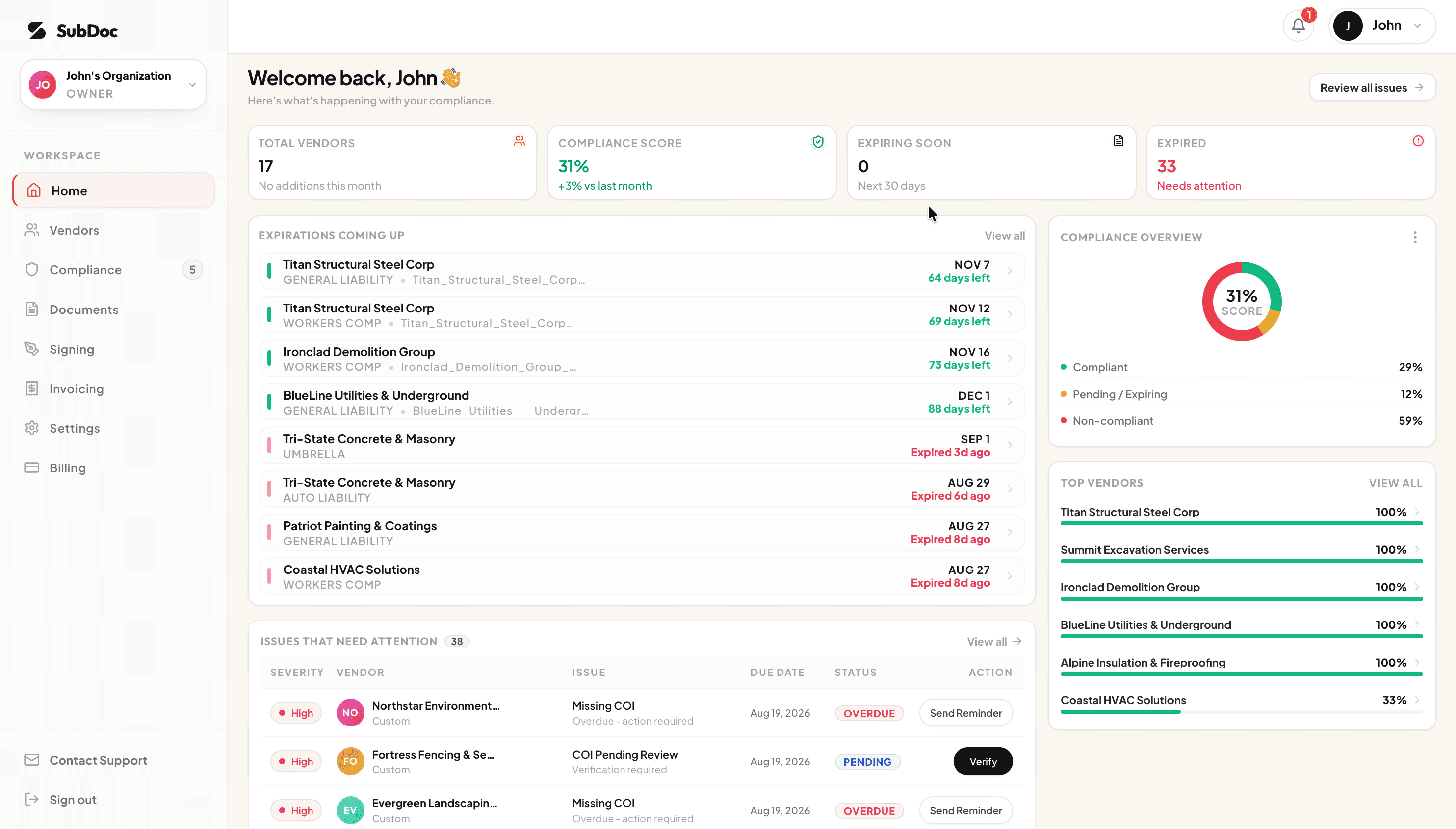
- Centralize vendor documents and keep completed signed paperwork available for review.
- Connect final invoice review with the invoice/compliance workflow. Your team determines approval and payment actions.
- Assign vendor and broker follow-up to your team; automated chasing is disabled.
Download the subcontractor closeout checklist template
Download this subcontractor closeout template as a CSV, then open it in Excel or another spreadsheet. It includes the checklist deliverables and separate columns for requirement, receipt, review, acceptance, exceptions, due date, location and continuing action. It also leaves space for retention instructions and legal-hold status. You can use it without a SubDoc account.
Download the editable closeout checklist (CSV)Replace generic requirements with clause references before sending the list. Give the subcontractor a short view of requested items and dates; keep internal acceptance decisions and legal review in the GC's copy. Add a separate row for each warranty or equipment manual when one acceptance decision cannot cover them all.
Review final subcontractor payment documents against the payment ledger, then test whether the accepted files are retrievable. Finish the subcontractor closeout checklist by assigning the next action on every open item. A complete final packet should tell the next person what was accepted, what remains unresolved and who owns it.
Frequently Asked Questions
Start with the subcontract and specifications. A packet may include work acceptance, final billing reconciliation, approved changes, applicable releases, warranties, manuals, record drawings and insurance evidence. Mark each item required or not applicable with a reason. Assign a reviewer who can decide whether the submitted evidence meets that specific requirement.
Identify the required submittals when the subcontract is set up, then confirm the request list before the final billing cycle. Give the subcontractor document names, formats, reviewers and contract-based due dates. Request items that need manufacturer or designer input early enough to allow corrections before the planned handoff.
A checklist alone does not authorize withholding. Payment rights, notice requirements, disputed amounts and release of retainage depend on the contract and applicable law. Record the missing item and its contractual basis, then confirm with counsel what action is permitted and when. Track payment deadlines separately from packet acceptance.
Review the subcontract before stopping. It may require insurance or additional insured protection after completion. Assign someone to request the evidence needed for those continuing duties, and preserve the historical insurance record separately. Confirm with your broker or carrier what the issued coverage establishes; final payment does not answer that question.
SubDoc supports centralized vendor documents, electronic signing and invoice/compliance workflow. Your team still reviews technical deliverables, resolves changes, interprets release requirements and assigns continuing obligations. Use the checklist alongside the workspace. Your team handles vendor and broker follow-up; SubDoc does not automatically chase them for missing closeout documents or renewals.
Related Guides
Keep the final documents within reach
Organize vendor documents, signed paperwork and invoice/compliance work in SubDoc while your team reviews the final packet.