Subcontractor Insurance Requirements by Trade: The 2026 General Contractor Checklist
A practical guide to setting, checking, and tracking trade insurance limits, endorsements, and project risks.
First, there is no single insurance package for every trade. In fact, subcontractor insurance requirementsvary by trade risk, contract size, and state laws. For example, finish trades need a baseline of $1,000,000 per occurrence and $2,000,000 aggregate CGL. In contrast, high-hazard trades like roofing, steel, demo, and excavation need $2,000,000 to $5,000,000 in primary coverage. In addition, general contractors must require statutory Workers' Comp, Commercial Auto, and key endorsements like CG 20 10 and CG 20 37.
Four Key Factors in Subcontractor Insurance Requirements
First, general contractors must review four core factors when setting subcontractor insurance requirements on any job:
First, state laws mandate statutory Workers' Comp and vehicle liability limits. Therefore, every trade must meet these rules before starting work.
Next, terms in your prime contract pass down to your subs. For example, the owner may require $5M umbrella limits or specific ISO riders.
In addition, trade risks vary widely. For instance, roofing and demolition need much higher coverage than interior trim work.
Finally, smart builders audit policy jackets. As a result, you catch open-roof or height exclusions before claims happen.
Table of Contents
1. Subcontractor Insurance Requirements by Trade (Master Table)
First, review the comparison table below for standard commercial contract limits. In addition, use the filters above to inspect high-hazard or specialty MEP trades.
| Trade Name | General Liability (Occ / Agg) | Workers' Comp & Auto | Umbrella Range | Critical Riders & Endorsements |
|---|---|---|---|---|
| ElectriciansModerate Risk | $1M / $2M (per project) | WC: Statutory ($1M Employer Liability) Auto: $1M CSL (Any Auto) | $1M to $5M | Arc testing riders, completed operations, design E&O |
| PlumbersModerate Risk | $1M / $2M | WC: Statutory ($1M Employer Liability) Auto: $1M CSL | $1M to $5M | Water damage completed ops, hot work torch rider, gas line pressure |
| HVAC ContractorsModerate Risk | $1M / $2M | WC: Statutory ($1M Employer Liability) Auto: $1M CSL | $1M to $5M | Contractors Pollution Liability (CPL), crane rigging, condensate leaks |
| RoofersHigh Hazard Risk | $1M / $2M to $2M / $4M | WC: Statutory ($1M Employer Liability) Auto: $1M CSL | $2M to $10M+ | Open roof rain rider, torch hot work endorsement, fall liability |
| Carpentry & FramingStandard Risk | $1M / $2M | WC: Statutory ($1M Employer Liability) Auto: $1M CSL | $1M to $3M | Structural load defect coverage, tool floaters, scaffolding safety |
| Concrete ContractorsModerate Risk | $1M / $2M | WC: Statutory ($1M Employer Liability) Auto: $1M CSL (transit rider) | $1M to $5M | Concrete boom pump rider, subsidence, shoring collapse |
| Masonry ContractorsModerate Risk | $1M / $2M | WC: Statutory ($1M Employer Liability) Auto: $1M CSL | $1M to $3M | Scaffolding liability, falling debris rider, silica dust compliance |
| Painting ContractorsStandard Risk | $1M / $2M | WC: Statutory ($500k to $1M) Auto: $1M CSL | $1M to $2M | Overspray liability buy-back rider, VOC vapor safety, ladder liability |
| Landscaping & SiteStandard Risk | $1M / $2M | WC: Statutory ($500k to $1M) Auto: $1M CSL (trailer rider) | $1M to $2M | Chemical herbicide rider, underground line strike (XCU), trailer towing |
| Demolition ContractorsHigh Hazard Risk | $2M / $4M | WC: Statutory ($1M Employer Liability) Auto: $1M to $2M CSL | $5M to $15M+ | Explosion, collapse, underground (XCU), pollution (CPL), asbestos riders |
| Excavation & GradingHigh Hazard Risk | $1M / $2M to $2M / $4M | WC: Statutory ($1M Employer Liability) Auto: $1M CSL | $2M to $5M | Underground utility strike (XCU), earth subsidence, trench safety |
| Steel & Structural ErectionHigh Hazard Risk | $2M / $4M | WC: Statutory ($1M Employer Liability) Auto: $1M CSL | $5M to $10M+ | Crane and rigging liability, rigger's hook rider, hot work welding |
2. Trade-by-Trade Subcontractor Insurance Requirements (12 Disciplines)
Below is the complete breakdown of subcontractor insurance requirements for each primary construction trade.
Electricians Subcontractor Insurance Requirements
Moderate RiskFirst, electrical work carries severe fire and arc flash risks. Therefore, electrician subcontractor insurance requirements mandate strong completed operations and testing coverage.
CGL: $1M per occurrence / $2M aggregate. In addition, require $1M to $5M umbrella coverage for commercial jobs.
For example, arc flash injuries, panel shorts, jobsite fires, and delayed wiring failures.
Next, verify active state licenses. Also, ensure no exclusions for electrical testing.
Plumbers Subcontractor Insurance Requirements
Moderate RiskFirst, water damage can spread across multiple floors in minutes. As a result, plumber subcontractor insurance requirements demand full completed operations without water seepage limits.
CGL: $1M per occurrence / $2M aggregate. Also, require $1M to $5M umbrella coverage for multi-story buildings.
For instance, solder torch fires, undetected joint leaks, multi-floor floods, and gas line explosions.
Next, check hot work safety permits. In addition, confirm continuous water damage coverage.
HVAC Contractors Subcontractor Insurance Requirements
Moderate RiskFirst, HVAC teams handle toxic refrigerants and heavy rooftop units. Therefore, HVAC subcontractor insurance requirements often include pollution and crane lift riders.
CGL: $1M per occurrence / $2M aggregate. In addition, mandate $1M to $5M umbrella limits.
For example, EPA refrigerant chemical spills, rooftop crane drops, and condensate pan leaks.
Next, verify EPA Section 608 certificates. Also, review crane lift rigging plans.
Roofers Subcontractor Insurance Requirements
High Hazard RiskFirst, roofing carries the highest fall and water intrusion claims in construction. Because of this, roofing subcontractor insurance requirements must be audited with extreme care.
CGL: $1M to $2M occurrence / $2M to $4M aggregate. Furthermore, require $2M to $10M+ in umbrella coverage.
For instance, severe worker falls, open-roof storm rain intrusion, and torch tar fires.
Next, inspect policy jackets for open-roof exclusions. In addition, verify hot work endorsements.
Carpentry & Framing Subcontractor Insurance Requirements
Standard RiskFirst, structural framing carries collapse hazards during wall erection. As a result, carpenter subcontractor insurance requirements focus on continuous completed operations.
CGL: $1M per occurrence / $2M aggregate. Also, require $1M to $3M umbrella limits.
For example, wall framing collapse, nail gun injuries, scaffolding falls, and load defects.
Next, verify fall protection training. In addition, check that condo exclusions do not apply.
Concrete Contractors Subcontractor Insurance Requirements
Moderate RiskFirst, concrete failures can compromise an entire building foundation. Therefore, concrete subcontractor insurance requirements demand broad property damage and transit auto coverage.
CGL: $1M per occurrence / $2M aggregate. In addition, mandate $1M to $5M umbrella coverage.
For instance, foundation settlement, pump line blowouts, cement chemical burns, and formwork collapse.
Next, check ready-mix transit auto endorsements. Also, confirm boom pump safety logs.
Masonry Contractors Subcontractor Insurance Requirements
Moderate RiskFirst, masonry work involves elevated scaffolding and falling brick hazards. Because of this, masonry subcontractor insurance requirements require rigorous jobsite safety riders.
CGL: $1M per occurrence / $2M aggregate. In addition, require $1M to $3M umbrella coverage.
For example, scaffold failures, falling bricks striking workers below, and silica dust exposure.
Next, check scaffold inspection logs. Also, verify OSHA silica dust plans.
Painting Contractors Subcontractor Insurance Requirements
Standard RiskFirst, exterior spray painting can damage dozens of parked cars in wind. As a result, painter subcontractor insurance requirements must include an overspray buy-back endorsement.
CGL: $1M per occurrence / $2M aggregate. Also, require $1M to $2M umbrella limits.
For instance, paint overspray drift on nearby vehicles, solvent fires, and toxic fumes.
Next, check for an overspray rider on the COI. In addition, inspect solvent storage plans.
Landscaping & Site Subcontractor Insurance Requirements
Standard RiskFirst, landscaping crews operate heavy mowers and tow utility trailers daily. Therefore, landscaping subcontractor insurance requirements focus on trailer auto and underground utility safety.
CGL: $1M per occurrence / $2M aggregate. In addition, require $1M to $2M umbrella coverage.
For example, mower rock strikes breaking windows, buried utility strikes, and chemical herbicide runoff.
Next, verify 811 utility locate tickets. Also, check state chemical applicator licenses.
Demolition Contractors Subcontractor Insurance Requirements
High Hazard RiskFirst, demolition presents severe collapse and dust explosion hazards. Because of this, demolition subcontractor insurance requirements demand the highest umbrella layers in construction.
CGL: $2M per occurrence / $4M aggregate. Furthermore, mandate $5M to $15M+ in umbrella coverage.
For instance, premature building collapse, buried pipe strikes, dust fires, and adjacent foundation cracks.
Next, review engineered demo plans. In addition, verify that vibration exclusions are deleted.
Excavation & Grading Subcontractor Insurance Requirements
High Hazard RiskFirst, trench cave-ins and severed gas mains can halt an entire project. As a result, excavation subcontractor insurance requirements mandate XCU coverage and subsidence riders.
CGL: $1M to $2M occurrence / $2M to $4M aggregate. Also, require $2M to $5M umbrella coverage.
For example, trench collapses, fiber optic strikes, water main floods, and soil settlement.
Next, confirm 811 locate tickets. In addition, inspect trench box safety certifications.
Steel & Structural Erection Subcontractor Insurance Requirements
High Hazard RiskFirst, erecting multi-story steel beams poses catastrophic crane and fall hazards. Therefore, structural steel subcontractor insurance requirements require substantial umbrella and rigging endorsements.
CGL: $2M per occurrence / $4M aggregate. Furthermore, require $5M to $10M+ umbrella coverage.
For instance, structural frame collapse, crane line snaps, ironworker falls, and welding fires.
Next, verify NCCCO crane operator credentials. Also, inspect hot work welding permits.
3. Core Coverages in Subcontractor Insurance Requirements
First, every builder must understand the core policies that make up subcontractor insurance requirements. Here are the six primary coverages:
First, CGL covers bodily injury and property damage from jobsite operations. In addition, general contractors must mandate CG 20 10 for ongoing work and CG 20 37 for completed operations.
Next, state law requires Workers' Comp for worker injuries. In addition, Employer Liability protects against third-party lawsuits with typical $1,000,000 limits.
Furthermore, commercial auto covers vehicles driving onto jobsites or hauling materials. For example, mandate Symbol 1 (Any Auto) with a $1,000,000 limit.
Also, umbrella coverage provides extra protection above primary policies. Therefore, high-hazard trades must carry $2,000,000 to $10,000,000 in follow-form umbrella limits.
In addition, CPL covers chemical spills, fuel leaks, and environmental cleanup. For instance, require CPL for HVAC, roofing, and demolition contractors.
Finally, Builders Risk covers damage to the structure under construction. However, subcontracts should hold subs responsible for deductibles caused by their negligence.
4. How General Contractors Set Subcontractor Insurance Requirements
First, general contractors should never apply a single blanket rule to all trades. Instead, set smart subcontractor insurance requirements using these six criteria:
First, divide trades into high, moderate, and standard risk tiers. As a result, scale umbrella limits to fit actual danger.
Next, compare contract values. For example, a $2M steel package warrants more coverage than a $20k trim package.
In addition, check your prime agreement. In fact, owner terms flow down and bind all trade subcontractors.
Furthermore, urban jobs with heavy pedestrian foot traffic demand higher auto and public liability limits.
Also, trades using open torches or working high above ground require strict hot work and fall safety riders.
Finally, require sub-tier contractors to provide matching insurance. In other words, never leave gaps down the chain.
5. Minimum vs Recommended Subcontractor Insurance Requirements
First, most commercial builders organize their subcontractor insurance requirements into three simple tiers:
| Tier Level | Required Coverage Limits | Trade Application Scope |
|---|---|---|
| Tier 1: Base Minimum | CGL: $1M / $2M WC: Statutory Auto: $1M CSL Umbrella: None or $1M | First, this applies to low-risk finish trades like painting, drywall, and trim. In short, it is the entry gate to any site. |
| Tier 2: Recommended Standard | CGL: $1M / $2M (Per Project) WC: Statutory ($1M Employer) Auto: $1M Any Auto Umbrella: $2M to $5M | Next, this is the commercial benchmark for MEP trades, concrete, and framing. As a result, it stops major water or fire claims. |
| Tier 3: High Hazard | CGL: $2M / $4M WC: Statutory ($1M) Auto: $2M CSL Umbrella: $5M to $15M+ | Finally, this applies to roofing, demo, structural steel, and deep excavation. In fact, it guards against catastrophic losses. |
6. What an ACORD 25 Certificate Proves (and Does Not Prove)
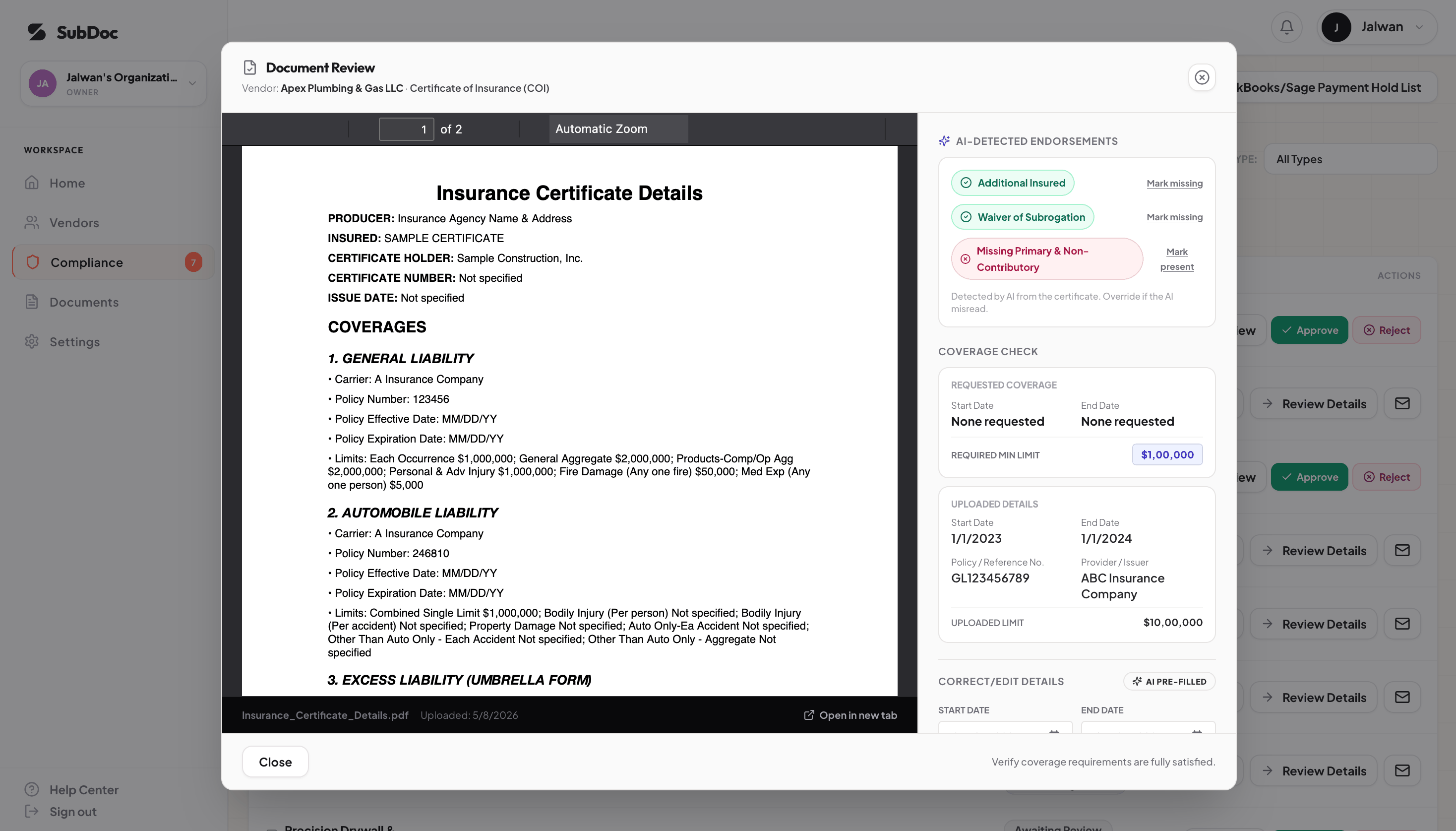
First, many builders mistakenly treat an ACORD 25 Certificate of Insurance as proof of coverage. In reality, it is only an informational summary.
Key Limits of an ACORD 25 Certificate
First, the top of every ACORD 25 form carries a clear disclaimer. For example, it states that the certificate confers no legal rights upon the holder.
First, it proves a policy was active when printed. Also, it shows basic stated limits and broker contact details.
However, it does not prove endorsements are attached. In addition, it does not reveal restrictive policy exclusions.
7. How to Verify Subcontractor Insurance Requirements
First, follow this 4-step process to verify subcontractor insurance requirements on every job:
- Step 1: Include Exhibit A During BiddingFirst, attach your insurance requirements to bid packets. As a result, trade contractors budget for necessary riders early.
- Step 2: Collect COIs 14 Days Before WorkNext, collect certificates directly from the broker. In other words, avoid accepting altered PDF copies from subs.
- Step 3: Audit Endorsements and ExclusionsThen, check that CG 20 10 and CG 20 37 are attached. In addition, verify that carrier A.M. Best ratings meet your standards.
- Step 4: Issue Jobsite Access BadgesFinally, only grant gate badges to approved crews. Therefore, uninsured trade workers cannot enter the jobsite.
8. Common Mistakes with Subcontractor Insurance Requirements
First, avoid these six common traps when managing subcontractor insurance requirements:
First, CG 20 10 only covers ongoing work. Therefore, without CG 20 37, you have zero defense if a pipe leaks months after handover.
Next, if the subcontract names "Apex LLC" but the COI says "Apex Inc," coverage can fail. As a result, check every entity match.
In addition, subs may cancel coverage after onboarding to save cash. Because of this, automated tracking is critical.
Furthermore, Symbol 7 only covers scheduled vehicles. Therefore, always mandate Symbol 1 (Any Auto) for trade trucks.
Also, brokers often hide height or residential exclusions in policy jackets. In short, audit the full endorsement pages.
Finally, without primary and noncontributory wording, your carrier must share defense bills with the sub's carrier.
9. Subcontractor Insurance Requirements Compliance Checklist
First, use this intake checklist to confirm subcontractor insurance requirements before cutting mobilization checks:
- • First, match the legal business name to W-9 and contract forms.
- • Next, confirm carrier A.M. Best rating of A- VII or better.
- • In addition, verify active dates cover the entire job timeline.
- • Finally, check certificate holder name and project address.
- • First, confirm occurrence-based policy form (ISO CG 00 01).
- • Next, verify $1M occurrence and $2M aggregate limits.
- • In addition, attach per-project aggregate rider (CG 25 03).
- • Finally, confirm no height, torch, or residential exclusions.
- • First, collect CG 20 10 for ongoing operations.
- • Next, collect CG 20 37 for completed operations.
- • In addition, verify CG 20 01 primary noncontributory wording.
- • Finally, confirm waiver of subrogation (CG 24 04 and WC 00 03 13).
- • First, verify statutory Workers' Comp for the project state.
- • Next, check $1,000,000 employer liability coverage.
- • In addition, inspect Box 7 for officer exemptions on the COI.
- • Finally, require $1,000,000 auto liability with Any Auto (Symbol 1).
10. Subcontractor Insurance Requirements Contract Template
Legal Note: This template provides standard educational wording. However, always consult your construction lawyer before signing agreements.
EXHIBIT "A": SUBCONTRACTOR INSURANCE REQUIREMENTS

Prior to starting any work on the site and before any payment is released,
Subcontractor shall obtain and keep active, at its own cost, with carriers
rated "A- VII" or better by A.M. Best, the following insurance coverages:

1. COMMERCIAL GENERAL LIABILITY (CGL):
   - Form: ISO Commercial General Liability Occurrence Form CG 00 01 (or equivalent).
   - Limits of Liability:
     * $1,000,000 Each Occurrence
     * $2,000,000 General Aggregate (Per Project Basis via ISO Form CG 25 03)
     * $2,000,000 Products and Completed Operations Aggregate
     * $1,000,000 Personal and Advertising Injury
   - Coverage Duration: Completed operations shall stay active through the state statute of repose.

2. WORKERS' COMPENSATION AND EMPLOYER'S LIABILITY:
   - Part 1: Statutory Workers' Compensation for the project state.
   - Part 2: Employer's Liability:
     * $1,000,000 Bodily Injury by Accident (Each Accident)
     * $1,000,000 Bodily Injury by Disease (Policy Limit)
     * $1,000,000 Bodily Injury by Disease (Each Employee)

3. COMMERCIAL AUTOMOBILE LIABILITY:
   - Limits: $1,000,000 Combined Single Limit (CSL) for injury and property damage.
   - Coverage: Symbol 1 ("Any Auto") or comprehensive coverage for Owned, Hired, and Non-Owned vehicles.

4. COMMERCIAL UMBRELLA / EXCESS LIABILITY:
   - Limit: $[1,000,000 / $2,000,000 / $5,000,000] Each Occurrence and Aggregate.
   - Form: Written on a strict Follow-Form basis over primary CGL, Auto, and Employer's Liability.

5. MANDATORY POLICY ENDORSEMENTS (Copies must be attached to the COI):
   - Additional Insured: ISO Form CG 20 10 (Ongoing Operations) AND ISO Form CG 20 37 (Completed Operations).
   - Primary & Noncontributory: ISO Form CG 20 01 stating Subcontractor's policy is primary.
   - Waiver of Subrogation: ISO Form CG 24 04 (CGL) and ISO Form WC 00 03 13 (Workers' Comp).

6. NOTICE OF CANCELLATION:
   - Subcontractor shall provide 30 days prior written notice (10 days for non-payment) for any policy change.
11. Subcontractor Insurance Requirements FAQ
Answers to common questions builders ask about trade insurance limits and verification rules.
First, most commercial general contractors require trade subcontractors to carry Commercial General Liability ($1,000,000 per occurrence and $2,000,000 aggregate). Second, subs must carry statutory Workers' Compensation. Third, they need Commercial Auto Liability ($1,000,000 CSL). In addition, higher-risk trades need $1,000,000 to $10,000,000 in umbrella liability.
First, GCs must enforce baseline subcontractor insurance requirements across all trades. For example, require occurrence-based CGL, Workers' Comp, and Commercial Auto. In addition, mandate follow-form Umbrella coverage. Finally, require critical endorsements like CG 20 10 for ongoing operations and CG 20 37 for completed operations.
First, standard finish trades usually carry $1,000,000 per occurrence and $2,000,000 general aggregate. However, high-risk trades like roofing and steel need $2,000,000 per occurrence and $4,000,000 aggregate. In addition, general contractors should require an umbrella policy of $2,000,000 to $10,000,000 for high-risk scopes.
Yes. In most states, any business with workers must carry statutory Workers' Compensation by law. However, even if a solo owner claims a state exemption, general contractors should require it contractually. In other words, this protects the GC from costly statutory employer claims if a helper gets hurt.
Yes. Any subcontractor driving trucks onto a jobsite must carry Commercial Auto Liability. For example, require at least a $1,000,000 Combined Single Limit. In addition, verify coverage applies to Any Auto (Symbol 1) or Owned, Hired, and Non-Owned vehicles.
First, commercial contracts use umbrella insurance to provide extra protection above primary limits. For example, standard interior trades carry $1,000,000 umbrella limits. In contrast, high-hazard trades like demolition and structural steel carry $5,000,000 to $15,000,000 umbrella policies.
First, electrician subcontractor insurance requirements include $1,000,000 / $2,000,000 CGL, statutory Workers' Comp, and $1,000,000 Auto. In addition, commercial jobs require $1,000,000 to $5,000,000 in umbrella coverage. Finally, verify that the policy does not exclude arc flash or electrical testing.
First, roofing subcontractor insurance requirements mandate $1,000,000 to $2,000,000 CGL and $2,000,000 to $10,000,000 in umbrella coverage. In addition, roofers must carry statutory Workers' Comp. Above all, GCs must verify the policy has no open-roof rain damage exclusions or torch fire restrictions.
First, plumbing subcontractor insurance requirements include $1,000,000 / $2,000,000 CGL and statutory Workers' Comp. In addition, plumbers need $1,000,000 to $5,000,000 umbrella coverage. As a result, this protects against massive multi-floor water leaks and gas line hazards.
First, require CG 20 10 for ongoing work and CG 20 37 for completed operations. Second, require CG 20 01 for primary and noncontributory protection. Third, require CG 24 04 for waiver of subrogation. Therefore, these endorsements stop the sub's insurer from pushing claim costs back onto your policy.
No. An ACORD 25 is only an informational summary. In fact, it explicitly states that it gives no legal rights to the certificate holder. Because of this, general contractors must always collect and review physical endorsement pages alongside the certificate.
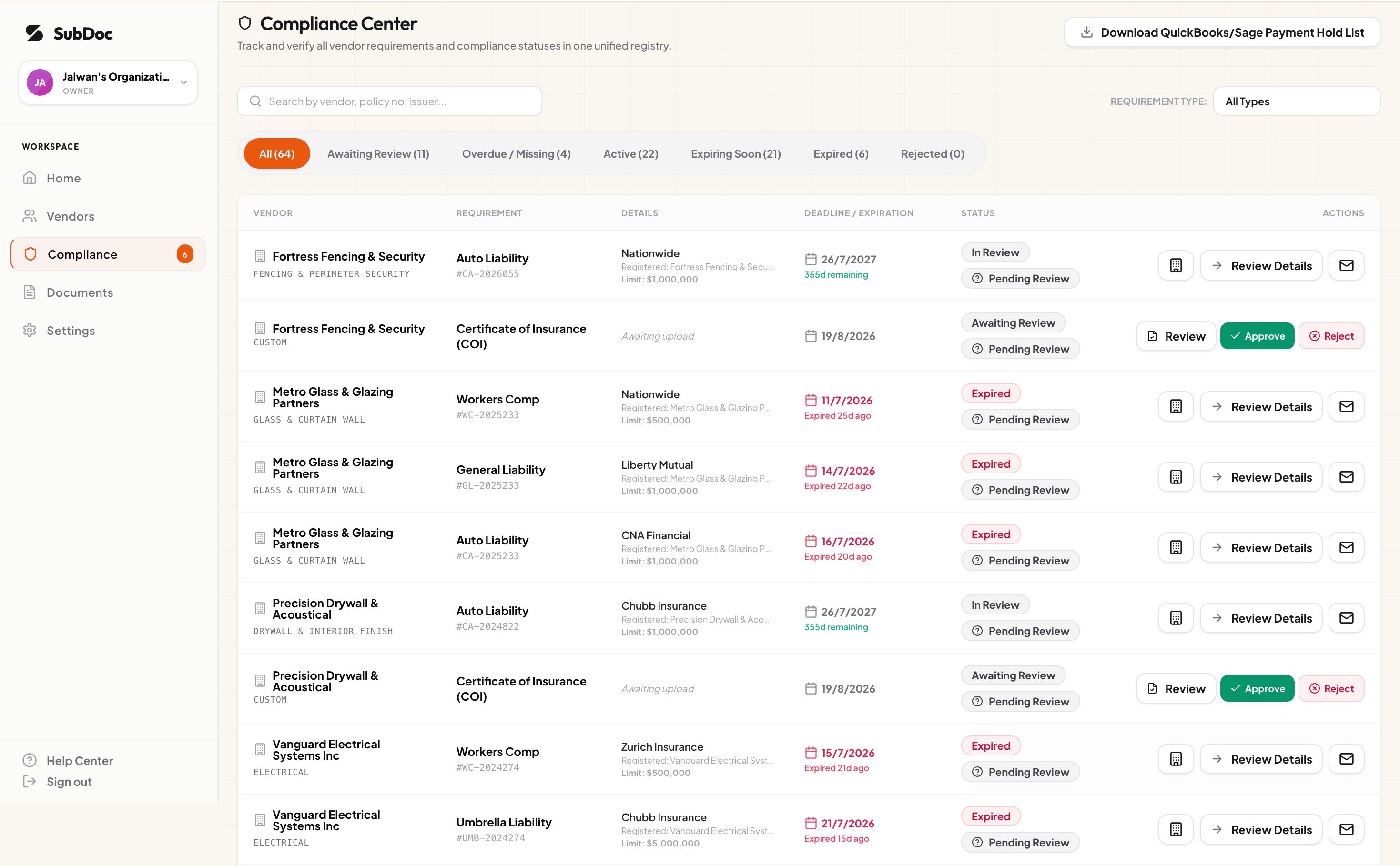
First, insurance checks are handled by GC risk managers, project admins, or automated compliance software like SubDoc. For example, these teams review COI limits and verify carrier ratings.
Yes. In fact, subcontractor insurance requirements vary based on building height, trade hazards, and owner contract rules. For example, high-rise urban jobs require much higher umbrella limits than single-story suburban projects.
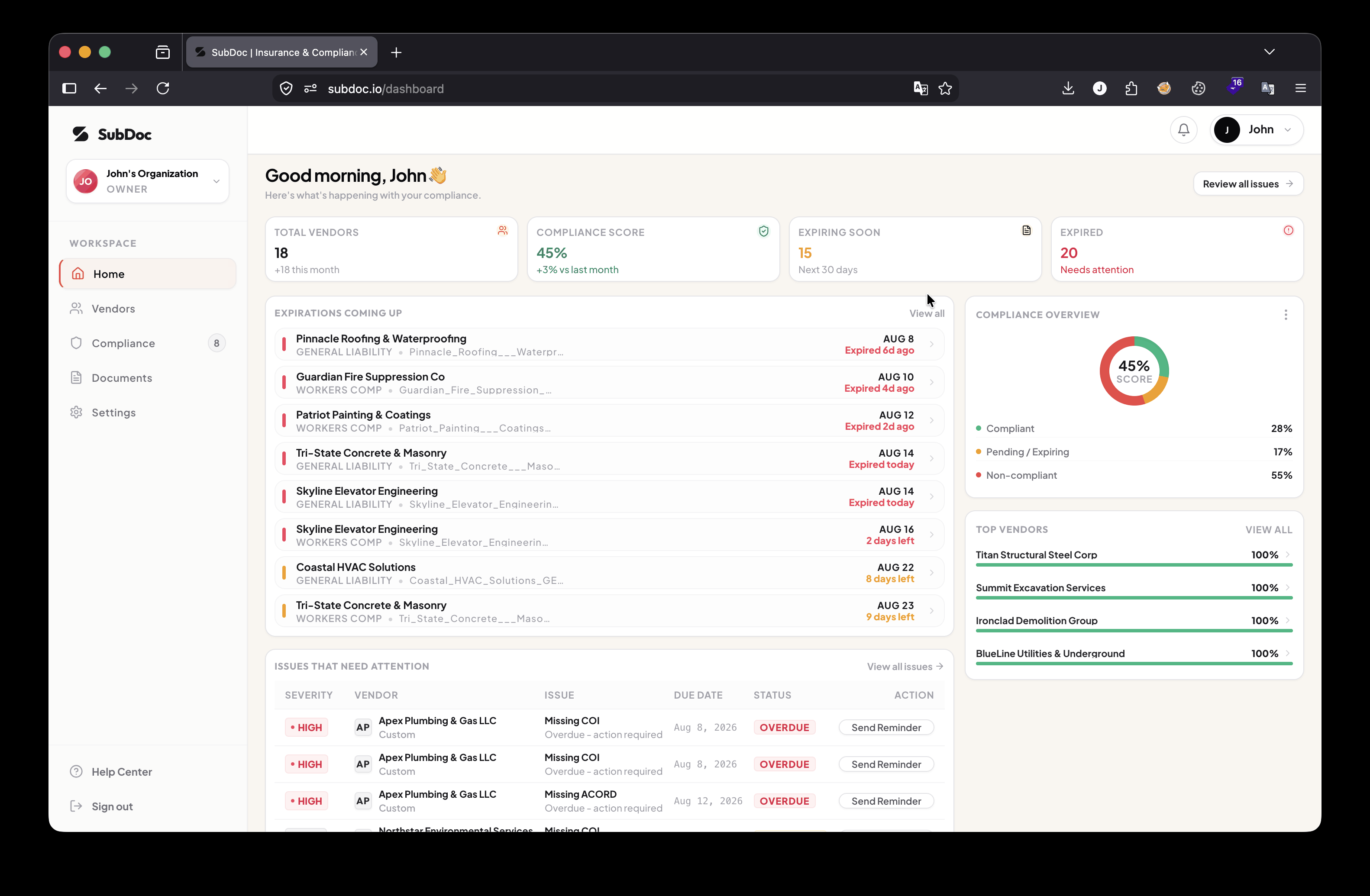
Automate Subcontractor Insurance Requirements with SubDoc
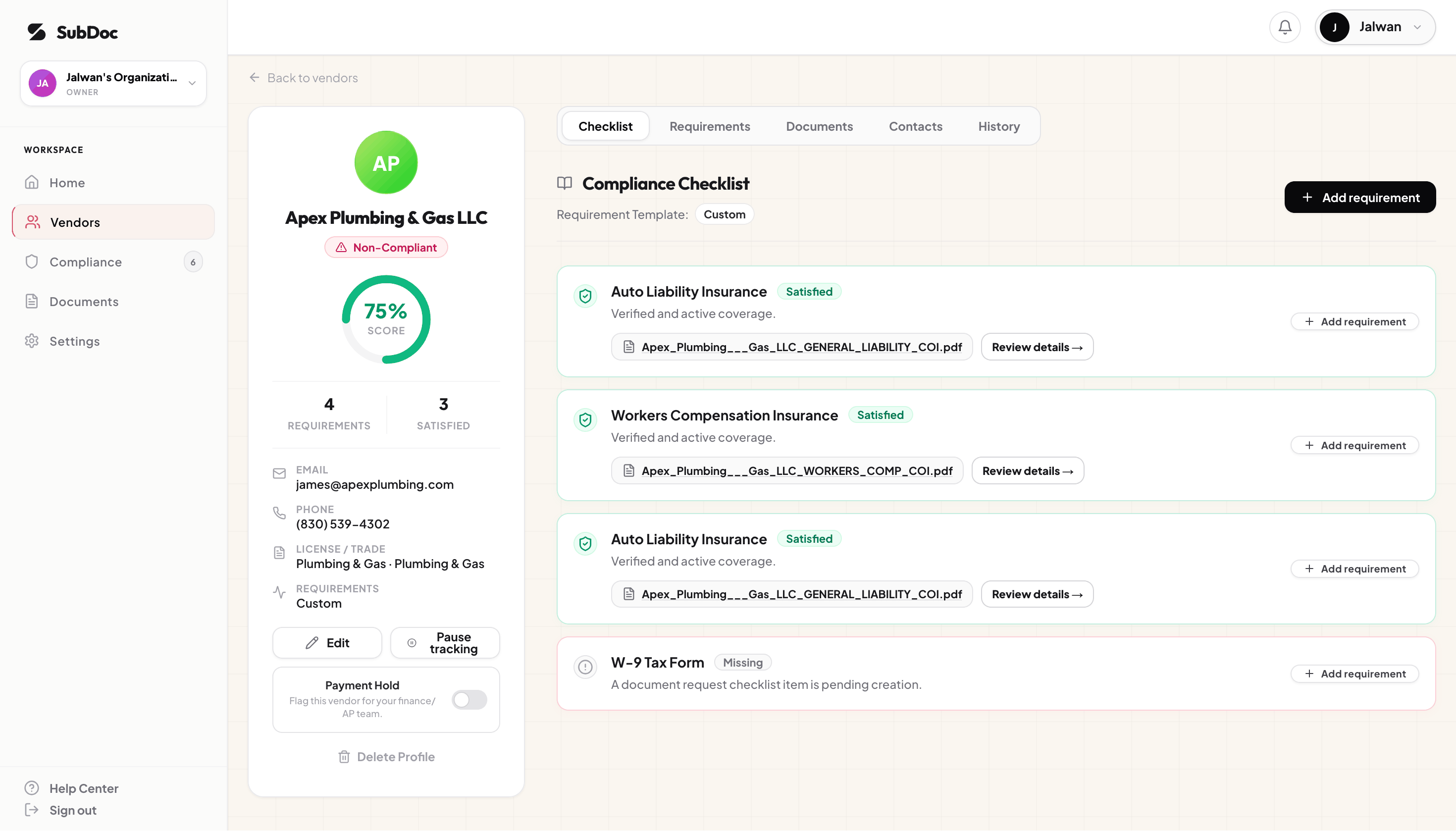
First, tracking trade insurance across spreadsheets leads to missed dates and costly audit fees. In contrast, SubDoc gives commercial general contractors an automated compliance engine:
- • Instant AI Review: First, AI reads ACORD 25 certificates and checks policy limits in seconds.
- • Endorsement Checks: Next, it flags missing CG 20 10 and CG 20 37 riders before crews enter jobsites.
- • No-Login Links: Finally, subs and brokers upload renewals via magic links without login friction.
13. Authoritative Sources & Industry References
First, the guidelines and endorsement codes in this article are based on primary standards from these industry bodies:
- 1. ACORD Corporation: ACORD Forms Program and ACORD 25 Guidelines. Retrieved September 2, 2026.
- 2. NCCI (National Council on Compensation Insurance): Basic Manual for Workers Compensation and Employers Liability Insurance, Rule 9 (Subcontractors). Retrieved September 2, 2026.
- 3. Insurance Services Office (ISO): Commercial General Liability Coverage Form (CG 00 01 04 13) and Endorsements (CG 20 10, CG 20 37) (form access requires ISO subscription). Retrieved September 2, 2026.
- 4. Bureau of Labor Statistics (BLS): Occupational Employment and Wages, Compliance Officers (Median $36.45/hr + 30% overhead ≈ $45/hr fully burdened rate used in calculations). Retrieved September 2, 2026.